You have had a stroke, or cerebrovascular accident (CVA). This is caused by a loss of blood flow to part of your brain. Ischemic type strokes can occur when a blood clot forms inside the carotid artery (main artery from the heart to the brain). Or a clot can form inside the heart and travel to the brain to lodge in a blood vessel and block blood flow. Another common ischemic cause of stroke is a gradual narrowing of the arteries in the brain because of a buildup of fatty deposits (plaque). A clot can form at such a narrowing. Less commonly, infection or cancer can cause ischemic stroke. An autoimmune disease can cause inflammation of the blood vessels and also lead to stroke.
A second type of stroke is hemorrhagic stroke. It occurs when a blood vessel ruptures and causes bleeding inside the brain.
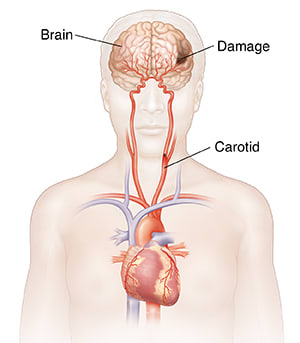
Symptoms
Blocked blood flow in different areas of the brain can cause different symptoms. If you have had a stroke before, a new one may be different. A memory aid for the basic signs of a stroke is B.E. F.A.S.T.
B.E. F.A.S.T.
- B is for balance. Sudden loss of balance or coordination.
- E is for eyes. Vision changes in one or both eyes.
- F is for face drooping. Drooping or numbness on one side of the face. This may be more noticeable when you ask the affected person to smile.
- A is for arm weakness or numbness. The affected person may have trouble using or lifting one side.
- S is for speech difficulty. Speech may be slurred or hard to understand. The affected person may also use the wrong words.
- T is for time to call 911. Time is critical in treating a stroke. Call
911 as soon as you suspect a stroke has happened—even a small one. The sooner treatment is started the better, even if the symptoms go away.
Other common symptoms of a stroke include:
- Having trouble getting the right words to come out.
- Weakness in one leg.
- Numbness on one side.
- Trouble walking.
- Trouble with coordination.
- Trouble with vision.
- Severe headache.
- Confusion.
- Dizziness.
Treatment
After you have had a stroke, you are at risk of having another. Be sure to follow up with your doctor for more assessment and treatment. If problems are found, your doctor will advise treatment with medicines, procedures, or both.
To reduce your chance of having another stroke, you may be prescribed medicines. These include medicines to prevent blood clots, such as antiplatelet or anticoagulant medicines. Certain heart conditions can be treated with surgery to reduce the risk for more strokes. Surgery to open up a blockage in the carotid artery (endarterectomy) may also reduce the risk for future strokes.
You will likely need physical therapy, including speech and occupational therapy if appropriate. This can be done at home, at an outpatient office, or in a rehabilitation hospital. Which location depends on your needs and abilities.
Home care
- Rest at home and don't exert yourself for the next few days.
- If your doctor has prescribed medicines, take them as directed.
Follow-up care
Follow up with your doctor as advised. Additional tests may be needed. If you had an X-ray, CT scan, MRI, or ECG (electrocardiogram), it will be reviewed by a specialist. You will be notified of any new findings that will affect your care.
Call 911
Call
- Any of your stroke symptoms worsen
- Sudden new problems with speech, confusion, vision, walking, coordination, facial droop, or weakness or numbness on one side of your body
- Severe headache, fainting spell, dizziness, or seizure
- Chest pain or shortness of breath
Remember B.E. F.A.S.T. (described above). If you notice warning signs and symptoms of stroke, call 911 right away.
Never drive yourself or the victim. The ambulance can alert the hospital and start treatment.

Related Articles
Understanding Your Cholesterol Numbers
The higher your total cholesterol number, the more likely it is that cholesterol will build up in your blood vessels. This sheet can help you track your cholesterol numbers.
Arteriovenous Malformations
Arteriovenous malformations (AVMs) happen when a group of blood vessels in your body forms incorrectly. Here's what you need to know.
Transesophageal Echocardiography (TEE)
Transesophageal echocardiography (TEE) is a test that allows your healthcare provider to record images of your heart from inside your esophagus, or food pipe.
Aortic Angiogram
An aortic angiogram is a test that takes pictures of the aorta. This is the main blood vessel that carries blood from your heart to the rest of your body. The test can show problems with your aorta, such as a blockage or an aneurysm (a balloon-like bulge in the wall of the aorta).


