Wisdom teeth that can't fully break through the gum (erupt) are called impacted. These teeth can grow in almost any direction, including:
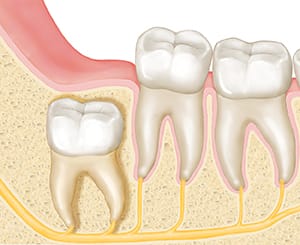
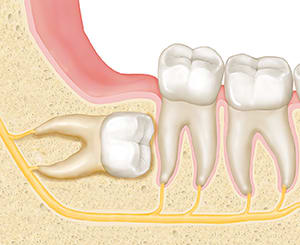
- Straight up, but without room to erupt into a healthy position.
- Angled away from the other teeth.
- Parallel to the gumline.
- Angled in toward the other teeth.
Problems caused by impacted teeth
Impacted wisdom teeth can cause sudden (acute) problems, ongoing (chronic) problems, or no problems at all. Removing the teeth before symptoms occur can prevent or reduce future problems. Dental X-rays can help your dentist find problems or help show if your wisdom teeth are likely to cause problems in the future. But it's not always clear if wisdom teeth will give you trouble. Possible problems include:
- Gum infection. As the tooth breaks through the gum, the gum can become infected. This causes pain, swelling, and sometimes bleeding.
- Chronic gum (periodontal) disease. Problems brushing and flossing at the back of the mouth can lead to gum disease. Or it may occur if bacteria and food debris collect under the gum tissue, covering an impacted tooth. Gum disease can lead to loss of a nearby molar.
- Tooth decay. Wisdom teeth can be hard to clean. This is because they're at the back of the mouth. This can lead to decay of both the wisdom tooth and the tooth next to it.
- Crowding. An impacted tooth can push on nearby teeth. It may force them out of their correct position. This can change your bite. Crowding can also damage teeth.
- Poor position. A tooth that grows pointing in toward the tongue or out toward the cheek can irritate nearby tissue. It may interfere with your bite. Problems can also occur if there's no matching tooth in the opposite jaw for the tooth to bite on.
- Cysts and tumors. A tooth that's embedded in the bone is encased in a sac. This sac can fill with fluid, forming a cyst. A cyst can damage roots of nearby teeth or destroy bone that supports teeth. In rare cases, a tumor forms in this area.
Talk with your dentist if you have questions about your wisdom teeth.

Related Articles
Understanding Gingivitis
Gingivitis is a type of gum disease. It is an inflammation of the gums that causes redness and swelling. It's most often caused by infection from bacteria on the teeth.
Dental Trauma
One or more of your teeth have been damaged. This can mean that the tooth is cracked or chipped. Or it can mean that the tooth has been knocked out of place. Read on to learn how to care for yourself at home.
Dental Pain
A crack or cavity in a tooth can cause tooth pain. Learn more about dental pain, such as possible sources, how to care for yourself at home, and when to call for help.
Dental Abscess
A dental abscess is an infection of the tooth socket. The infection causes pain and swelling of the gum, cheek, or jaw.


