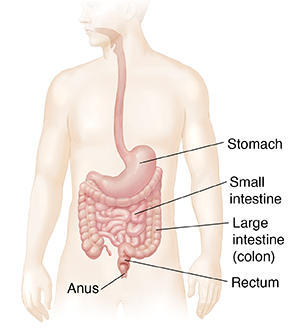
When you eat, food enters your digestive tract. This is a series of organs that form a pathway from your mouth to your anus. As food moves down this pathway, it is processed and changed to waste. The nutrients are absorbed in the body. After food is changed to waste, it is pushed out of your body in a bowel movement.
-
The stomach breaks down food into a liquid mixture.
-
The small intestine absorbs nutrients from the liquid mixture. What remains is liquid waste.
-
The large intestine (colon) absorbs water from the liquid waste, converting it into solid waste (stool).
-
Nerves along your digestive tract tell your muscles how fast to contract.
-
Muscles in the intestines contract to move food and waste through the digestive tract.
-
The rectum stores stool until a bowel movement happens.
-
The anus is the opening where stool leaves the body.

Related Articles
Irritable Bowel Syndrome (IBS)
Irritable bowel syndrome (IBS) is a condition that affects your large intestine or colon. When you have IBS, your colon looks normal. But it does not work the way it should.
What Is GERD?
If you often have a painful burning feeling in your chest after you eat, you may have GERD (gastroesophageal reflux disease).
How the Colon Works
Read on to learn more about the colon, including some helpful diagrams.
Anatomy of the Digestive System
As food moves along the digestive tract, it is digested. This means it's changed into substances that can be absorbed into the bloodstream.


