Body mass index (BMI) is a way to figure out your weight category. It uses the ratio of your height to your weight. BMI is a measure of your weight that is corrected for height. Knowing your BMI is a way to tell if you are at a healthy weight, underweight, or overweight. The higher your BMI, the greater your risk for weight-related health problems.
What BMI means for adults
-
BMI below 18.5: Underweight
-
BMI 18.5 to 24.9: Healthy weight or ideal body weight
-
BMI 25 to 29.9: Overweight
-
BMI 30 and over: Obese
-
BMI 40 and over: Severe obesity
Use an online tool
Go online and search for BMI calculators. Try the Centers for Disease Control and Prevention (CDC) website. Or go to the American Cancer Society website. Both have online BMI tools.
Using the BMI chart
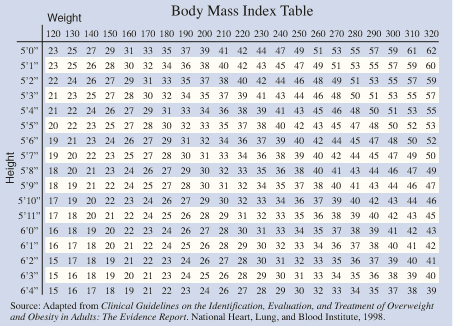
To figure out your BMI, find your height and weight (or the numbers closest to them) on the table below. Follow each column of numbers to where your height and weight meet on the table. That is your BMI.
Featured in

Related Articles
When Your Child Needs Surgery: Anesthesia
During surgery, your child will receive anesthesia. This is medicine that causes your child to relax or fall asleep, and not feel pain during surgery. See below for more information about different types of anesthesia.
Having Bowel Surgery: Proctocolectomy with Permanent Ileostomy
This surgery is done to treat diseases of the digestive tract. It removes all of the large intestine. When healed, waste passes from the small intestine through an opening (stoma) in the belly wall and into a pouch outside of the body.
Tonsil, Adenoid, and Ear Tube Surgery: Going to Surgery
Your child will be cared for by a surgical team. This team will include a surgeon, and one or more nurses, and other health professionals. An anesthesiologist or nurse anesthetist will give your child medicine to make him or her fall asleep. Here is information about your child's surgery.
Recovery After Procedural Sedation (Child)
Your child was given medicine before their procedure. Most of the effects will wear off before your child goes home. But drowsiness may continue for the first 6 to 8 hours after the procedure. Here's what you should know and look out for over the next 12 to 24 hours.


