You have Barrett esophagus. This means that there have been changes to the lining of the esophagus near the stomach. The changes may have been caused by the acid reflux that happens with GERD (gastroesophageal reflux disease). The changed lining isn't cancer. But it may increase your chances of developing cancer later on.
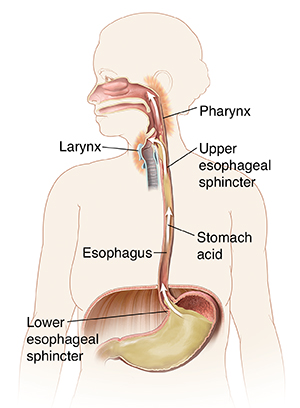
When you have GERD
The esophagus is the tube that carries food and liquid from the mouth to the stomach. Your lower esophageal sphincter (LES) is a 1-way valve at the top of the stomach. It keeps food and stomach acid from flowing backward. If the LES is weakened, food and stomach acid flow back (reflux) into your esophagus. If this happens often, the condition is called GERD.
Changes in the lining
The stomach is kept safe from its own acid by a special lining. The esophagus isn’t meant to contact stomach acid. But a small amount of acid reflux is normal and occurs in many people. With GERD, acid flows back into the esophagus often. This damages the esophagus. In response to the damage, new tissue forms that isn't normal. This is Barrett esophagus. The new tissue may keep changing. This is why it's more likely to become cancer in the future.
Preventing further damage
Your healthcare provider may suggest regular tests to keep track of changes in the esophagus. This often includes an endoscopy, when a flexible lighted scope is placed through the mouth into the esophagus. Tissue samples (biopsies) can be taken of the abnormal areas. You're sedated with an IV (intravenous) medicine for comfort.
Your provider may also suggest ways for you to control GERD. This includes lifestyle changes such as quitting smoking and staying at a healthy weight. Medicine or even surgery may also be suggested. This should help keep your Barrett esophagus from getting worse. If it does get worse, more treatment is often done during an endoscopy.
Symptoms of GERD
Symptoms include:
-
Heartburn
-
Sour-tasting fluid backing up into your mouth
-
Frequent burping or belching
-
Symptoms that get worse after you eat, bend over, or lie down
-
Coughing repeatedly to clear your throat
-
Hoarseness
-
Trouble swallowing

Related Articles
The Digestive Process: Digestion Begins in the Mouth
Digestion is a multistep process that begins the moment you place a piece of food in your mouth or sip some juice.
What You Need to Know About Vomiting
Learn about what to do if you or a child has nausea or vomiting.
The Digestive System: An Overview
Detailed information on how the digestive system works, including a full-color, labeled illustration of the digestive system.
The Digestive Process: How Does the Esophagus Work?
Your esophagus has 1 main purpose: to move food from your throat to your stomach. Here's how it works.


