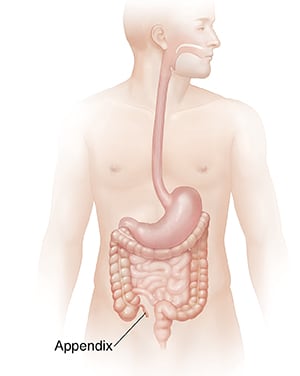
An appendectomy is surgery to remove the appendix. The goal is to remove the appendix safely. In most cases, the surgery takes about 30 to 60 minutes. If your appendix has burst, surgery may take longer.
Before surgery
- Before surgery, you'll be asked to sign an informed consent. Signing this form means you understand the risks and benefits of the procedure. Be sure all of your questions are answered before you sign.
- Tell your doctor about all the medicines you take. This includes prescription and over-the-counter medicines. It also includes vitamins, herbs, and other supplements.
- You may get fluids, antibiotics, and other medicines through an I.V. (intravenous) line. Tell your doctor if you're allergic to any medicines or have any other health concerns.
- You'll be given anesthesia just before your appendectomy. This keeps you pain-free and allows you to sleep during the surgery.
Types of surgery
An appendectomy may be done in two ways. Your surgeon will discuss which method is best for you:
- Open surgery. One cut (incision), several inches long, is made in your lower right side. A bigger incision may be used if the appendix has burst.
- Laparoscopic surgery. About two to four small incisions are used. One is near your belly button. The others are on other parts of your belly (abdomen). A thin tube with a tiny camera attached (laparoscope) is inserted through one incision. The camera shows the inside of your abdomen on a video screen. This image helps guide the surgery. Tiny surgical tools are put into the other incisions.
Finishing the surgery
In most cases, the full incision is closed with stitches or staples. Your surgeon may place a short-term (temporary) drain in the wound or in your abdomen. This helps remove any extra fluid. This may help prevent infection. This drain is usually taken out before you're discharged. If your appendix has burst, the outer layers of the incision may be left open. Leaving the skin open prevents infection from forming under the skin. It may heal on its own. Or it may be closed about five days later.
After the surgery
Keep any advised follow-up appointments with your doctor. If you're told to take any medicines, take them as directed. If you're given breathing exercises, do them as directed. After the surgery, your removed appendix is checked under a microscope. Your doctor will tell you the results.
When to contact your doctor
Contact your doctor if you have any of these:
- Swelling, oozing, pain that gets worse, or redness near the incision
- A fever of
100.4° F (38° C) or higher, or as advised by your doctor - Belly pain that gets worse
- Severe diarrhea, bloating, or constipation
- Upset stomach (nausea) or vomiting
- Leg pain or swelling
Call 911
Call
Featured in

Related Articles
Treating Hemorrhoids: Surgery
You may need surgery for hemorrhoids if they cause severe symptoms. Or you may have it if your hemorrhoids come back after you have tried other treatments. Read on to learn what to expect.
Hernia Repair Surgery
A hernia won't heal on its own. You'll need surgery to fix the defect in the abdominal wall. Read on to learn what to expect before, during, and after surgery.
Appendectomy: Overview
An appendectomy is surgery to remove the appendix when it is infected. This condition is called appendicitis. Appendectomy is a common emergency surgery.
Having Laparoscopic Cholecystectomy
You've had painful attacks caused by gallstones. Because of this, you are having surgery to remove your gallbladder. This is called cholecystectomy. A method called laparoscopy will be used. This allows surgery to be done through a few small incisions.


