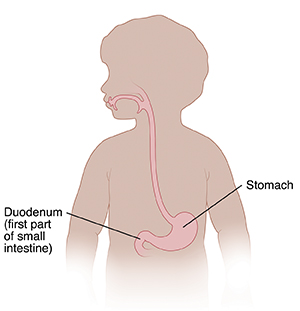
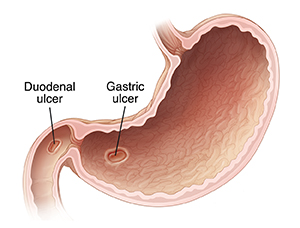
An ulcer is a breakdown of tissue on the inside of the stomach or small intestine. This causes a sore to form. An ulcer can form in the stomach. This is called a gastric ulcer. Or one can form in the first part of the small intestine (duodenum). This is called a duodenal ulcer. In children, ulcers are often caused by an infection with bacteria, such as Helicobacter pylori (H. pylori). Or they may be caused by certain medicines, such as NSAIDs (nonsteroidal anti-inflammatory drugs). They may also be caused by secondhand smoke, genetics, and an increase in stomach acid. Children whose parents have gastric or duodenal ulcers are more likely to have ulcers.
What are the symptoms of an ulcer?
Common symptoms of a gastric or duodenal ulcer include:
-
Burning feeling, cramping, or pain that feels like hunger in the belly. This often happens 1 to 3 hours after a meal, or in the middle of the night.
-
Pain that gets better or worse with eating.
-
Burping.
-
Upset stomach (nausea) or vomiting.
-
Feeling full quickly when eating.
-
Signs of blood in vomit.
-
Black poop (stool) that's sticky like tar. This means the ulcer is bleeding.
-
Weight loss.
How are ulcers diagnosed?
The health care provider will ask about your child’s symptoms. Your child may also need a test. Common tests for an ulcer include:
-
Upper GI series. This is a series of X-rays of the digestive tract.
-
Endoscopy. This test uses a thin, flexible tube with a tiny camera attached (endoscope). The endoscope is put into your child’s mouth and lowered down into the stomach. This allows the provider to see the ulcer. This tube may also be used to take a tiny tissue sample (biopsy) to find out if an ulcer is caused by H. pylori bacteria.
-
Blood, breath, or stool tests. These can help show an infection that can cause an ulcer.
How are ulcers treated?
Ulcers in children are most often treated with medicine. It may take 8 to 12 weeks of medicine to relieve your child’s symptoms and heal the ulcer. The most common medicines are:
-
H-2 blockers and proton pump inhibitors. These help by preventing acid from being made in the stomach.
-
Antibiotics. These treat an infection from H. pylori bacteria. Give your child all of the antibiotics as prescribed.
Long-term concerns
A child who has had an ulcer is more likely to have one again. Watch your child for ulcer symptoms. If your child has any symptoms, contact their health care provider right away.
If an ulcer isn't treated, a serious problem called perforation can occur. This is a hole through the stomach or intestinal wall. Emergency surgery will likely be needed to fix a perforation.
Untreated ulcers can also cause unintended weight loss and ongoing belly (abdominal) pain. A bleeding ulcer can cause low levels of red blood cells in the blood (anemia).
When to contact your doctor
Contact your child’s health care provider right away if you see signs that your child’s ulcer is worse or perforated. Watch for:
-
Fever.
-
Blood in the vomit.
-
Severe belly pain.
Featured in

Related Articles
Food Poisoning (Infant/Toddler)
Dehydration is the main concern when a child has food poisoning. This sheet can help you care for your sick child at home.
When Your Child Has Diarrhea
Diarrhea is one of the most common illnesses in children. It can lead to too much fluid loss (dehydration) which can be serious. So preventing dehydration is important in managing your child's diarrhea. Here's what you need to know.
When Your Child Has Celiac Disease
Celiac disease is a problem that affects your child's ability to get nutrients from food. It is caused by a sensitivity to gluten. This is a protein found in many grains. Celiac cannot be cured, but it can be managed and the damage reversed.
Bacterial Gastroenteritis (Child)
Dehydration is the main concern when a child has gastroenteritis. This sheet will help you care for your child at home.