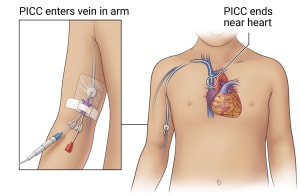
Your child has a peripherally inserted central catheter (PICC) in place. This is the flexible tube in a vein in their arm that leads to a large vein near their heart. It is used to give them medicines, fluids, or nutrition as needed. Below is what to expect when it’s time for your child to have their PICC removed.
Before PICC removal
Your child’s healthcare team will tell you when your child’s PICC can be removed. Ask questions and tell them any concerns you may have. Explain the procedure to your child in an age appropriate way.
During PICC removal
-
Your child may be asked to lie down. They will rest their arm on a pillow or table.
-
The dressing over the PICC will be removed.
-
Your child will be asked to stay still. They may be asked to hold their breath for a short time while the PICC is removed.
-
The healthcare provider will gently pull the PICC line out. Your child may feel mild pressure or a pulling feeling.
-
When the PICC is out, the healthcare provider will apply gauze and press on the site. This is to help stop bleeding. They will keep pressure on the site for as long as needed.
-
They will then put a sterile dressing on the site. This is to protect it and let it heal.
After PICC removal
-
Keep the site clean and dry for
24 to 48 hours . After that, you can remove the bandage. -
Don’t let your child shower for
24 to 48 hours . After that, you can wash the PICC site gently. Pat the skin dry. Don’t rub. -
Watch for signs of infection. These include pain, redness, warmth, swelling, or fluid leaking.
-
Don’t let your child lift anything heavy or do strenuous activity for
48 hours . -
Don’t let your child immerse the PICC site in water for
1 to 2 weeks . This means they should not take a bath, or go in a pool or hot tub.
After the PICC site heals, your child may have a small scar.
When to contact the doctor
Contact the doctor if your child has any of these:
-
Bleeding at the PICC site that won’t stop
-
Pain at the PICC site
-
Signs of a blood clot, such as swelling and pain in the arm where the PICC was
-
Signs of infection at the PICC site, such as redness, warmth, swelling, or fluid leaking
-
Fever (see Fever and Children below)
-
Chills
-
Trouble breathing
Fever and children
Use a digital thermometer to check your child’s temperature. Don’t use a mercury thermometer. There are different kinds and uses of digital thermometers. They include:
-
Rectal. For children younger than 3 years, a rectal temperature is the most accurate.
-
Forehead (temporal). This works for children age 3 months and older. If a child under 3 months old has signs of illness, this can be used for a first pass. The provider may want to confirm with a rectal temperature.
-
Ear (tympanic). Ear temperatures are accurate after 6 months of age, but not before.
-
Armpit (axillary). This is the least reliable but may be used for a first pass to check a child of any age with signs of illness. The doctor may want to confirm with a rectal temperature.
-
Mouth (oral). Don’t use a thermometer in your child’s mouth until they are at least 4 years old.
Use a rectal thermometer with care. Follow the product maker’s directions for correct use. Insert it gently. Label it and make sure it’s not used in the mouth. It may pass on germs from the stool. If you don’t feel OK using a rectal thermometer, ask the doctor what type to use instead. When you talk with any doctor about your child’s fever, tell them which type you used.
Below is when to contact the doctor if your child has a fever. Your child’s doctor may give you different numbers. Follow their instructions.
When to contact a doctor about your child's fever
For a baby under 3 months old:
-
First, ask your child’s doctor how you should take the temperature.
-
Rectal or forehead: 100.4°F (38°C) or higher
-
Armpit: 99°F (37.2°C) or higher
-
A fever of ___________as advised by the doctor
For a child age 3 months to 36 months (3 years):
-
Rectal or forehead: 102°F (38.9°C) or higher
-
Ear (only for use over age 6 months): 102°F (38.9°C) or higher
-
A fever of ___________ as advised by the doctor
In these cases:
-
Armpit temperature of 103°F (39.4°C) or higher in a child of any age
-
Temperature of 104°F (40°C) or higher in a child of any age
-
A fever of ___________ as advised by the doctor
Date Last Reviewed: 02/01/2025
© 2000-2026 The StayWell Company, LLC. All rights reserved. This information is not intended as a substitute for professional medical care. Always follow your healthcare professional's instructions.

Related Articles
Vascular Access Port Implantation
Vascular access port implantation is surgery to place a port under your skin. This allows medicine or nutrition to be sent right into your bloodstream. Here's what you need to know about the procedure.
The Operating Room
Your child will need to know that people in the operating room will be wearing surgical clothes to help prevent germs from infecting the surgical incision.
Wound Care After Surgery: Pain
It's normal to feel pain at the incision site. The pain decreases as the wound heals. Pain that continues more than a few weeks after surgery or pain that gets worse any time after surgery can be a sign of a problem.
The Hospital Surgical Setting for a Child
Many surgeries performed on children are done as an outpatient. With minor surgeries, your child will return to the outpatient surgery center after spending the needed time in the recovery room.


