Introduction
Here are some examples of exercises for you to try. The exercises may be suggested for a condition or for
rehabilitation. Start each exercise slowly. Ease off the exercises if you start to have pain.
You will be told when to start these exercises and which ones will work best for you.
How to do the exercises
Big-toe flexor stretch
-
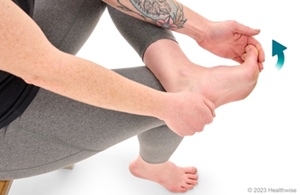
Sit in a chair, and put your affected foot across your other knee.
-
Grasp your heel with one hand and then slowly pull your big toe back with your other hand. Pull your toe
back toward your ankle until you feel a stretch along the bottom of your foot. -
Hold the stretch for 15 to 30 seconds.
-
Repeat 2 to 4 times.
-
It's a good idea to repeat these steps with your other foot.
Big-toe extensor stretch
-
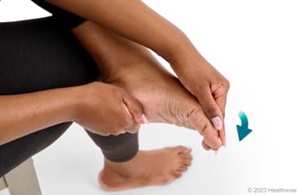
Sit in a chair, and put your affected foot across your other knee.
-
Grasp your heel with one hand and then slowly push your big toe down with your other hand. Push your toe
down and away from your ankle until you feel a stretch along the top of your foot. -
Hold the stretch for 15 to 30 seconds.
-
Repeat 2 to 4 times.
-
It's a good idea to repeat these steps with your other foot.
Big-toe traction stretch
-
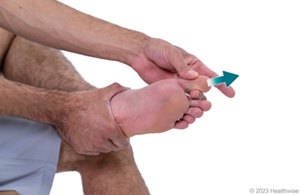
Sit in a chair, and put your affected foot across your other knee.
-
Grasp your heel and the middle part of your foot with one hand. With your other hand, use your thumb and
middle finger to grasp your big toe and gently pull it straight out and away from your foot. -
Hold the stretch for 15 to 30 seconds.
-
Repeat 2 to 4 times.
-
It's a good idea to repeat these steps with your other foot.
Forefoot stretch
-
Sit in a chair with your affected leg bent, and put the heel of your affected foot on the edge of the
seat. Or you can sit on the floor with your leg bent and your heel resting on the floor. -
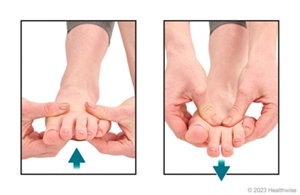
Grasp your foot with both hands. Your thumbs will be on the top side of your foot just below the joints
where your toes connect to your foot. Your other fingers will be underneath your foot. -
Use the fingers underneath your foot to push up on the two toes that are closest to your big toe. Then
use your thumbs and hands to spread your foot and toes outward until you feel a stretch in your foot. The
outer edges of your foot will curve downward as you push up on the middle toes. Hold the stretch for 15 to
30 seconds. -
Next, slowly press your thumbs down on the two toes that are closest to your big toe. The outer edges of
your foot will curve upward. Hold the stretch for 15 to 30 seconds until you feel a stretch in your foot. -
Repeat 2 to 4 times.
-
It's a good idea to repeat these steps with your other foot.
Towel scrunch
-
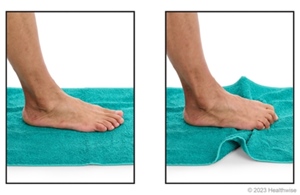
Sit in a chair, and place your affected foot on a towel on a hard floor (not a floor with carpet).
-
Scrunch the towel toward you with your toes. Then use your toes to push the towel back into place.
-
Repeat 8 to 12 times.
-
It's a good idea to repeat these steps with your other foot.
Make this exercise more challenging by placing a weighted object, such as a soup can, on the other end of
the towel.
Marble pickups
-
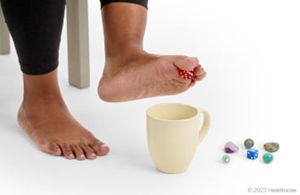
Put some marbles, dice, or small smooth rocks on the floor next to a cup.
-
Sit in a chair, and use the toes of your affected foot to lift up one item from the floor. Then try to
put the item in the cup. -
Repeat 8 to 12 times.
-
It's a good idea to repeat these steps with your other foot.
Follow-up care is a key part of your treatment and safety. Be sure to make and go to all
appointments, and call your doctor if you are having problems. It's also a good idea to know your test results
and keep a list of the medicines you take.
Current as of: July 17, 2023
Content Version: 14.0
Care instructions adapted under license by your
healthcare professional. If you have questions about a medical condition or this instruction, always ask
your healthcare professional. Healthwise, Incorporated disclaims any warranty or liability for your use of
this information.


Related Articles
Discharge Instructions: Removable Cast Care (Child)
Your child will be going home with a removable cast (sometimes referred to as a splint). A cast helps your child’s body heal by holding injured bones or joints in place. A damaged cast can keep the injury from healing well. Take good care of your child’s cast. Here's what you need to know about home care.
Cast Care: Types of Casts and Cast Aids
Several types of casts are available to help injuries heal. Your doctor will decide what type of cast will work best for your injury.
Preparing Your Residual Limb for a Prosthesis
Learn what to expect after amputation as you prepare for a prosthesis.
Headache After Spinal Tap (With Patch)
After the patch, you should start to feel better soon. Improvement often continues over the next several days.


