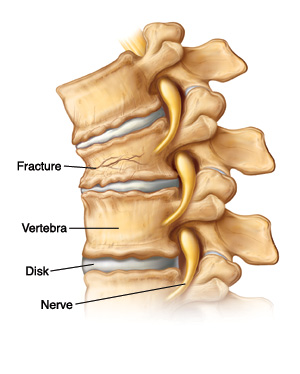
You have a crushed vertebra. This is a compression fracture of one or more bones in your spine. This kind of break usually happens in older people with thinning of the bones called osteoporosis. It may happen after a ground-level fall or even with a very minor force. This can include bending forward, getting up from a seated position, coughing, or sneezing.
It may also occur in young healthy people after a severe injury, such as a car accident or a fall from a height. This is generally a stable break.
This means the spine doesn't need to be surgically realigned or fused. And it usually doesn't cause any injury to the spinal cord or nerves. This injury often takes 1 to 3 months to heal. It can be treated at home with short-term bed rest and pain medicine.
Short-term prescription or over-the-counter (OTC) pain medicine can be used to control the pain. Long-term use of pain medicine can increase the risk of side effects. If you have chronic liver or kidney disease, or if you ever had a stomach ulcer or gastrointestinal bleeding, talk with your health care provider before using these OTC medicines. If pain medicine is needed for more than 1 to 2 weeks, talk with your provider about other treatment options, such as lidocaine patches or muscle relaxants.
A back brace or abdominal binder may be prescribed. This reduces pain by limiting motion at the fracture site. If you have osteoporosis, talk with your provider about using calcium and vitamin D3 supplements. You may need prescription medicines to prevent further bone loss. If you take corticosteroids, smoke, or take nicotine products, or if you had a bariatric surgery, talk to your provider about how this affects your bones. An exercise program to increase spine strength is a very important part of the treatment plan. It should start after the pain is under control.
If you have severe and lasting pain, your provider may advise a procedure called a vertebral augmentation. In this procedure, a needle is used to inject bone cement into the fractured vertebra.
Home care
-
You may need to stay in bed for the first few days. But start sitting or walking as soon as you can. This will help prevent problems with prolonged bed rest, such as muscle weakness, muscle wasting, worsening back stiffness and pain, and blood clots in the legs.
-
When in bed, try to find a comfortable position. A firm mattress is best. Try lying flat on your back with pillows under your knees. You can also try lying on your side with your knees bent up toward your chest and a pillow between your knees.
-
Don't sit for long periods of time. This puts more stress on the low back than standing or walking.
-
Apply an ice pack over the injured area for 15 to 20 minutes every 3 to 6 hours. You should do this for the first 24 to 48 hours. To make an ice pack, put ice cubes in a plastic bag that seals at the top. Wrap the bag in a thin towel or cloth before using it. You can start with ice, then switch to heat after 2 days. Apply heat (warm shower or warm bath) for 15 to 20 minutes several times a day for muscle spasms. Some people feel best alternating ice and heat treatments. Use the one method that feels the best to you. Be careful not to injure your skin with the ice or heat treatments. Ice should never be applied directly to skin. Warm rather than hot heat should be used to protect skin areas that have decreased sensation.
-
Take pain medicine as directed. Call your health care provider if your pain isn't well-controlled. A dose change, stronger medicine, or other treatment options may be needed.
-
Be aware of safe lifting methods. Don't lift anything over 10 pounds until all the pain is gone.
Follow-up care
Follow up with your health care provider as advised. If X-rays were taken, you'll be told of any new findings that may affect your care.
Call 911
Call
-
Weakness or numbness in one or both legs.
-
Loss of control over your bowels or bladder.
-
Numbness in the groin area.
When to get medical advice
Contact your health care provider or seek medical care right away if the pain gets worse or spreads to your arms or legs.


Related Articles
Discharge Instructions: Caring for Your Removable Cast (Splint)
A removable cast, or splint, helps your body heal by holding your injured bones or joints in place. Here are instructions on how to care for it.
Discharge Instructions: Using a Jewett Brace
A Jewett brace keeps your back in position while it is healing after surgery or injury. Wear your brace as directed by your doctor.
Discharge Instructions: Using a Thoracolumbar Sacral Orthosis Brace (TLSO)
Your health care provider has prescribed a thoracolumbar sacral orthosis brace (TLSO) for you. A TLSO is a back brace. It's used to keep your back straight after surgery to help treat scoliosis or a spine fracture. Using the TLSO correctly will help you move on your own.
Understanding Spinal Cord Disease
Spinal cord disease can cause a loss of sensation and movement. Learn more about resources that can help you.


