For certain types of neck pain, your health care provider may suggest a cervical epidural injection. During this procedure, medicine (such as numbing medicine and a steroid) is injected deep into your neck near your spine. The injection helps the provider find the source of your pain. It can also help ease your pain and soreness for a short time or a long time. Ask your provider about the risks and benefits of the procedure.
The cervical vertebrae
The cervical vertebrae are the bones that support your neck and head. They form the top part of your spine. The tunnel made by these vertebrae is called the spinal canal. The spinal cord runs through the spinal canal and inside a sac called the dura. Nerves branch off the spinal cord and exit between the vertebrae. Pressure on one of these nerves may cause it to become inflamed. An inflamed nerve in your neck may cause pain, numbness, tingling, or weakness that you may feel in your neck, head, or arms.
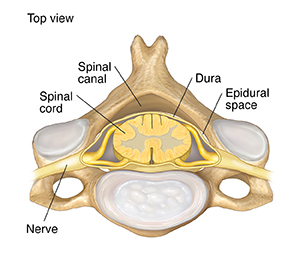
The cervical epidural injection
In certain conditions, medicine can be injected into the epidural space. This space surrounds the dura within the spinal canal. An anesthetic (numbing medicine) is used to reduce discomfort from the procedure. Then a needle is inserted between the bones of the neck. When the correct location is reached, the medicine may be injected. The injection is usually done with the help of imaging, such as fluoroscopy. This helps guide the needle to exactly the right position. Care is taken to reduce the chance of infection from the procedure. Infection is rare, but can be serious. The procedure will be done by a health care specialist, such as a neurosurgeon, a pain specialist, an interventional radiologist, or an anesthesiologist.
Possible risks and complications
-
Infection
-
Spinal headaches
-
Bleeding
-
Nerve damage
-
Spinal cord damage
-
Prolonged increase in pain
Serious complications of various types have been reported. Talk with your health care provider about the possible side effects and when they should be reported.


Related Articles
Having Minimally Invasive Lumbar Diskectomy
This is a type of surgery to fix a disk in the lower back. Minimally invasive surgery uses 2 or more small cuts (incisions) instead of 1 large incision. This may lead to less pain after surgery, and faster recovery.
Types of Lumbar Disk Surgery
You have a problem disk in your lower back. This disk problem may be corrected with a diskectomy. This is the surgical removal of a part of a disk. There are 3 types of diskectomy. Each has risks and benefits. Your surgeon will advise the type that's best for your back and your health.
Vertebroplasty
Vertebroplasty is a procedure used to treat fractures or breaks in the vertebrae. In this procedure, a thick cement mixture is injected into a fractured vertebra to stabilize the spine.
Facet Joint Injection: Your Experience
Learn what to expect when you get a facet joint injection.


