Low back and leg pain is often because of damage to 1 or more of the disks between the vertebrae. Electrothermal therapy uses heat to change the structure of the tissue inside the disk. It doesn’t relieve pain right away. Pain is reduced as the disk heals. After healing, the disk may also be stronger and more stable than before. This treatment is also called intradiscal electrothermal therapy.
Inside the disk
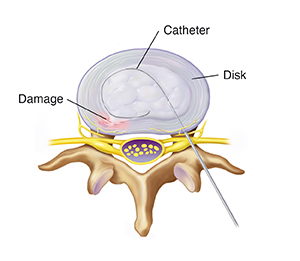
First, a needle is inserted into the disk. Then a special flexible wire (catheter) is threaded through the needle, so that it curves around the inside of the disk. When the catheter is in place, part of it is next to the damage in the disk.
Heating the disk
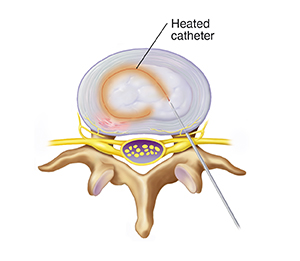
Once the catheter is in place, it's heated slowly to a high temperature. The catheter is kept at that temperature for a few minutes. Then it's removed. The heat may deaden nerves in the disk, preventing these nerves from causing pain. The heat may also make the disk shrink. This may mean that the disk no longer presses on nerves. The heated tissue will slowly heal over the next few months and form scar tissue. This scar tissue may:
-
Plug any leak in the disk
-
Make the disk stronger
Risks and possible complications
The risks and complications of electrothermal catheter therapy include:
-
Bleeding
-
Spinal fluid leak
-
Infection
-
Nerve damage
-
Worsened pain after recovery
-
No improvement of pain


Related Articles
Foot Surgery: Bunions
A bunion is a bony bump. When the distance between the first and second metatarsal bones of the foot is greater than normal, the big toe may turn toward the other toes. A mild bunion may then form causing foot pain and swelling. Bunions are most often found near the joint at the base of the big toe. Bunions tend to run in families. They may cause pain, swelling, and skin irritation.
Understanding Transforaminal Lumbar Interbody Fusion (TLIF)
A fusion is a surgery to join two or more bones together. During a transforaminal lumbar interbody fusion (TLIF), this is done on the spine. Learn more about why and how TLIF is done and what the risks are.
Your Amputation Surgery
Amputation is surgery to remove a limb. Learn about the surgery and what to expect after.
Knee Replacement Surgery
When your knee is badly damaged by disease or injury, a knee replacement may be considered. During knee replacement surgery, your joint surfaces are replaced by prostheses. These are plastic and metal parts that are used to replace your joint surfaces. Read on to learn more.


