Reverse total shoulder replacement is a type of shoulder surgery. It’s usually done to repair the shoulder joint if you have a completely torn rotator cuff with shoulder arthritis.
Understanding the shoulder joint
The shoulder joint is where the ball-shaped part of the upper arm bone (humerus) meets the cup-shaped socket of the shoulder blade (scapula). A group of muscles and tendons hold the joint together. These muscles and tendons are called the rotator cuff. The muscles let you move your arm and shoulder.
Why reverse total shoulder replacement is done
The surgery may be needed if you have a complete tear of your rotator cuff. The tear may cause long-term problems with your shoulder joint. This is called cuff tear arthropathy. You may need reverse total shoulder replacement surgery if you have:
-
A complete tear in your rotator cuff.
-
Joint problems from the cuff tear (cuff tear arthropathy).
-
Symptoms that didn't go away after a previous total shoulder replacement surgery.
-
Severe pain and trouble moving your shoulder.
-
No relief with treatments such as rest, medicines, cortisone injections, or physical therapy.
How reverse total shoulder replacement is done
The surgery is the opposite (reverse) of standard total shoulder replacement surgery:
-
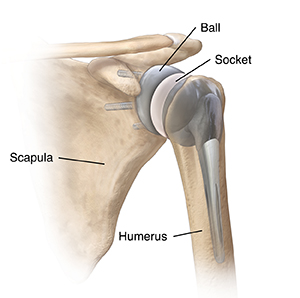
In the standard surgery, the ball of the humerus is replaced with an artificial ball. The socket of the scapula is replaced with an artificial socket. The new joint still uses the rotator cuff muscles to move the arm and shoulder.
-
With the reverse surgery, the ball of the humerus is replaced with an artificial socket. The socket of the scapula is replaced with an artificial ball. Since the rotator cuff muscles are damaged, another muscle (deltoid) moves the arm and shoulder.
Risks of reverse total shoulder replacement
Every surgery has risks. Risks for this surgery include:
-
Infection.
-
Blood loss.
-
Damage to nerves that may make it hard to move your arm.
-
Damage to the humerus or scapula.
-
The artificial joint moving out of position (dislocation).
-
Stiffness, pain, and limited function.
-
Problems with anesthesia.
Some risks may be higher if you've had shoulder surgery in the past. Your risks may vary depending on your shoulder problem and your overall health. Talk with your doctor about which risks apply most to you.


Related Articles
Surgery for Shoulder Impingement: Your Experience
Surgery can help free up space in your shoulder joint. This relieves symptoms of impingement. Prepare for surgery as instructed. If you don’t, your surgery may have to be rescheduled. Your healthcare provider will give you instructions for recovering at home. If you have any questions, be sure to get them answered.
Hip Arthroscopy: After Surgery
Know what to expect after arthroscopy on your hip.
Knee Arthroscopy: Conditions Treated
Arthroscopy is used to find and treat knee problems. These include tears in the meniscal cartilage, joint loose bodies, or anterior cruciate ligament (ACL) tears.
Treating Corns and Calluses
Learn about the different treatments for corns or calluses.


