Minimally invasive scoliosis surgery is a type of surgery done to fix an abnormal curve of the spine known as scoliosis. Minimally invasive surgery uses 2 or more small cuts (incisions) instead of a single large incision. This may lead to less pain after surgery and a faster recovery. Minimally invasive scoliosis surgery is not available at all hospitals or other places that do surgery.
What is scoliosis?
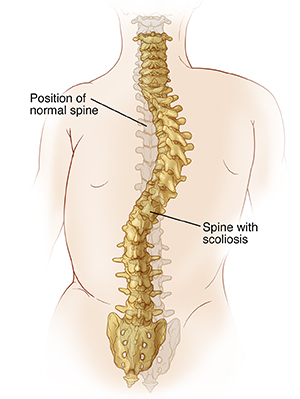
The spine has some normal curves forward and backward. But it should not curve to the side. With scoliosis, the spine curves to the side in an S-shape or a C-shape. If the curve is severe, it can cause uneven shoulders. Your child’s body can appear to tilt to one side. There are many types of scoliosis. The most common type of scoliosis is idiopathic. This means the exact cause is unknown.
Why is minimally invasive scoliosis surgery done?
Your child may need surgery if their spine has a severe curve. This is a curve of at least 40° or a curve that is rapidly getting worse. Or your child may need surgery in the future if other treatments, such as bracing, don’t keep the curve from getting worse. Children who have only mild curves are not likely to need surgery. Your child’s doctor will keep track of your child’s spine as they grow. Surgery is the only treatment that can make the spine straight. It can correct posture. It can also reduce or relieve pain.
Minimally invasive scoliosis surgery can cause less harm to back muscles and other nearby tissues. It also uses smaller incisions. This can lead to less pain and a shorter recovery pain after surgery. Your child may not be able to have minimally invasive scoliosis surgery if their curve is very severe.
How minimally invasive scoliosis surgery is done
The surgery is done by an orthopedic surgeon with a trained medical team. The surgeon will use a special type of X-ray to view the surgery. They will make a small incision on your child’s back in the area that needs to be treated. They will put a tubular retractor into this incision. This will expose the part of the spine to be treated. The surgeon will then pass small tools through this retractor. This includes a tiny camera and a light. The doctor will partly straighten the spine. This is done using screws, rods, and wires. The surgeon may use a bone graft to complete the repair. Bone is used from your child’s hip or from a donor.
Risks of minimally invasive scoliosis surgery
Every surgery has risks. Risks of minimally invasive scoliosis surgery include:
-
Infection.
-
Excess bleeding.
-
Pain at the graft site.
-
Nerve damage.
-
Blood clots.
-
Not enough bone formation.
-
Lung complications (rare).
-
Need for a repeat surgery.
Your child's risks may differ depending on age, general health, shape of the curve, and the surgery method. Having the surgery at a place that is experienced in the method can help lower your child's risks. Talk with your child's doctor about the risks that most apply to your child.
Featured in


Related Articles
Kneecap Surgery: Removing Damaged Cartilage
Surgery may be used when pain severely limits your activities. Or it may be done when a rehab program or other nonsurgical treatments just are not helping enough. Some procedures may be done using arthroscopy. This method uses tiny incisions and special instruments to look and work inside the knee joint. Other procedures need open surgery.
Foot Surgery: Curled Fifth Toe
A curled fifth toe is most often inherited. When the fifth toe curls inward, it moves under the next toe. Then the nail of the curled toe starts to face outward. As a result, you may bear weight on the side of your toe instead of the bottom. This can cause corns and painful nails. There are many nonsurgical treatments available. But if these are not effective, surgery is a choice.
Minimally Invasive Scoliosis Surgery for Children
Minimally invasive scoliosis surgery is a type of procedure done to fix an abnormal curve of the spine known as scoliosis. This type of surgery uses smaller incisions than open surgery.
Hip Arthroscopy: After Surgery
Know what to expect after arthroscopy on your hip.


