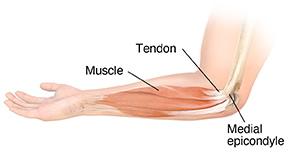
Several muscles attach to the arm at the elbow joint. The tough bands of tissue that attach muscle to bones are called tendons. The bone in the upper arm has knobs on the farthest end called epicondyles. Tendons attach some arm muscles to these knobs. The tissues in this area can become irritated.
Epicondylitis is the medical term for a painful, inflamed elbow over the epicondyle. Medial refers to the inner side of the elbow. Medial epicondylitis is sometimes called “golfer’s elbow.”
How to say it
MEE-dee-uhl eh-pih-KOHN-dih-li-tihs
Causes of medial epicondylitis
A painful inner elbow may be caused by:
-
Using an elbow or hand the same way over and over.
-
Using poor form or too much force in a sport such as golf, tennis, or baseball.
-
Lifting too heavy a weight.
-
Other injuries to the arm or elbow.
Symptoms of medial epicondylitis
-
Pain or tenderness on the inside of the elbow that may travel down the forearm
-
Pain when moving the wrist
-
Pain or weakness when gripping something
-
A crackling sound or grating feeling when moving the elbow
Treatment for medial epicondylitis
Treatments may include:
-
Preventing or changing the action that caused the problem. This helps prevent irritating the tissues more.
-
Prescription or over-the-counter medicines. These help reduce inflammation, swelling, and pain.
-
Braces. A counter-force brace can help reduce tendon strain. This allows the joint to heal.
-
Cold or heat packs. These help reduce pain and swelling.
-
Stretching and other exercises. These improve flexibility and strength.
-
Physical therapy. This may include exercises or other treatments.
-
Injections of medicine. This may relieve symptoms.
If other treatments don't relieve symptoms, you may need surgery.
Possible complications
If you don’t give your elbow time to heal, symptoms may return or get worse. Follow your health care provider’s instructions on resting and treating your elbow.
When to contact your doctor
Contact your provider right away if:
-
You have a fever of 100.4°F (38°C) or higher, or as directed by your provider.
-
Chills
-
The redness, swelling, or warmth gets worse.
-
Your symptoms don’t get better with prescribed medicines, or they get worse.
-
You have new symptoms.
Author: Freed. Becca
© 2000-2026 The StayWell Company, LLC. All rights reserved. This information is not intended as a substitute for professional medical care. Always follow your healthcare professional's instructions.

Related Articles
Rib Contusion or Minor Fracture
A rib fracture (bone break) may cause the same symptoms as a rib contusion. Treatment for both is the same.
Open Finger Fracture
You have a broken finger (fracture) with a nearby cut, puncture, or deep scrape. This causes local pain, swelling, and bruising. Because of the open injury, you are at risk for infection in the skin and bone. You will take antibiotics to lower the risk for infection.
Knee Sprain
A sprain is an injury to the ligaments or capsule that holds a joint together. Here's how to care for yourself at home.
Understanding Lateral Epicondylitis
This condition, also called tennis elbow, is an inflammation around the bony knob (lateral epicondyle) on the outer side of the elbow. It occurs when the tissue that attaches muscle to the bone becomes irritated.


