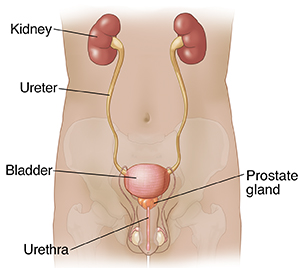
Your urinary tract helps to get rid of your body’s liquid waste. Here's how it works:
-
The kidneys. These constantly filter the blood to collect unneeded chemicals and water, making urine.
-
Ureters. Urine travels through the ureter tubes to the bladder.
-
The bladder. This fills with urine, holding it until you’re ready to release it. Signals from the brain tell the muscles around the opening of the bladder (sphincter) when to let urine flow out of the bladder.
-
Urethra. This is the tube that carries urine from the bladder out of the body.
-
Prostate gland. In men, the prostate gland wraps around the urethra near the bladder.

Related Articles
Discharge Instructions: Bladder Training with a Suprapubic Catheter
You are going home with a suprapubic catheter, which is a tube that drains urine from your bladder. You'll need to train your bladder to work as it did before. Read on to learn more.
Ureteral Stricture Surgery (Ureteroplasty)
Ureteroplasty is surgery to remove a narrowing (stricture) in the ureter. Learn what to expect with this procedure.
Protein in the Urine (Proteinuria)
Proteinuria occurs when some of the normal protein in the bloodstream ends up in the urine. Protein in the urine will show up on a standard urine test. Protein in the urine can be a sign of serious disease or a harmless temporary condition.
Understanding Varicocele Embolization
Varicocele embolization is a procedure to treat an enlarged vein in the scrotum. Varicoceles often form during puberty. Learn about how the procedure is done.


