Interstitial cystitis is a painful condition of the bladder. People with interstitial cystitis have a bladder wall that is tender and easily irritated. This leads to uncomfortable symptoms. The disorder can affect women and men, but is more common in women.
Interstitial cystitis is ongoing (chronic). This means it has no cure. But it can be managed to help you feel better. Many types of treatment can help manage symptoms and pain. Some may work well for one person and not for another. More than one treatment may be tried. Your health care provider can find what works best for you.
Oral medicines
Your provider may prescribe 1 or more medicines. Most patients with interstitial cystitis need to try more than one treatment, sometimes in combination, to find one that provides the best relief. Ask your provider about all of your choices.
-
Pain medicine. This may include nonsteroidal anti-inflammatory medicines and certain seizure medicines. They may help reduce inflammation and ease pain.
-
Cyclosporine A. This is a medicine that suppresses the immune system.
-
Antispasmodic medicines. These may help relax the bladder muscles and decrease the need to urinate.
-
Antihistamines. Oral antihistamines, such as hydroxyzine, may help reduce inflammation and ease pain.
-
Antidepressants. In low doses, certain antidepressants may block pain and help ease symptoms.
-
Pentosan polysulfate sodium and similar medicines. These can restore the bladder lining. It can take 3 to 6 months of treatment to see improvement.
Bladder instillation
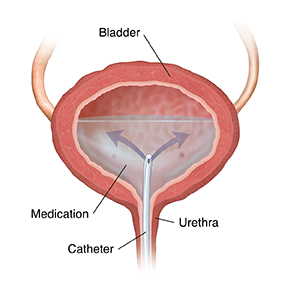
Bladder instillation is also called bladder wash, bath, or cocktail. It may help ease your inflammation. It may also help repair the bladder’s lining. During the treatment, the bladder is filled with liquid medicine. This is done with a thin tube (catheter). You will hold the medicine in your bladder for
Bladder hydrodistention
Hydrodistention is a procedure to stretch the walls of the bladder. It's done by filling the bladder with fluid. You may have had this procedure to diagnose your interstitial cystitis. Some people have relief from symptoms for a time afterward.
Sometimes hydrodistention can be combined with cystoscopy. This is a procedure in which a thin tube with a camera at the end is placed in the bladder through the urethra. It takes pictures that help find the cause of symptoms. Some patients with interstitial cystitis have bladder lesions called Hunner lesions. If these lesions are seen, they can be treated during the cystoscopy.

Related Articles
Partial Cystectomy
Partial cystectomy is surgery to remove part of the bladder. It is most often done to treat bladder cancer. After the surgery, the bladder will still function. Here's what you can expect before, during, and after the procedure, including your recovery in the hospital and at home.
Incontinent Urinary Diversion
Urinary diversion is surgery that makes a new way for urine to pass out of the body. It may be needed if the bladder is diseased or damaged. It may also be done if another problem in the body keeps the bladder from working correctly. Learn how the surgery is done.
Treating Incontinence in Women with Medicine
Urinary incontinence is the leaking of urine from the bladder. In some cases, medicine can reduce or stop the leaking. It is mainly given for urge incontinence. Your healthcare provider will talk with you about your choices.
Ureteral Reimplantation Surgery
With ureteral reimplantation surgery, one or both ureters are moved so their connection to the bladder is stronger. Read on to learn details about this surgery.


