The steps below show how to get and keep an erection with a vacuum erection therapy system.
The three parts of a vacuum erection device (VED) include:
-
A plastic tube (cylinder).
-
A hand-operated, battery-operated, or electric pump.
-
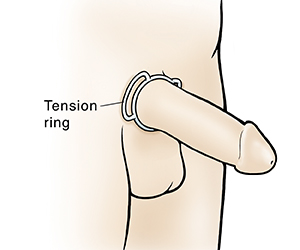
A rubber tension ring, which fits on one end of the tube.
Getting started
-
Place the rubber tension ring on the open end of the cylinder.
-
Apply a water-based lubricant to the end of the cylinder. Do NOT use petroleum jelly. It could damage the device.
-
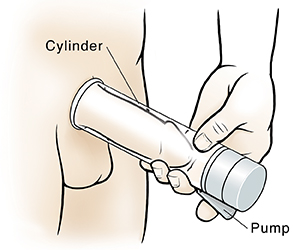
Put your penis into the cylinder. Hold the cylinder firmly against your belly (abdomen) to create a seal. Take care not to pinch the scrotum.
Getting an erection
-
Squeeze the hand pump or turn on the electric pump to pull the air out of the tube. This will create a vacuum. Blood will be drawn into your penis, and your penis will become erect and firm.
-
Use only the amount of vacuum pressure needed for an erection. Too much pressure can cause injury to your penis.
-
Follow the instructions you’ve been given for using your particular brand of pump.
-
It may take some practice before you get optimum erections.
Using the tension ring
-
When your penis is fully erect (often less than 5 minutes), roll the tension ring off the cylinder onto the base of your penis. The tension ring holds blood in your penis, creating an erection. The area behind the ring remains soft and flexible.
-
Remove the cylinder from your penis.
-
After no longer than 30 minutes, remove the tension ring from your penis. To do this, grasp the tabs on the ring and pull to stretch the ring.
-
Keeping the ring on for longer than 30 minutes could seriously bruise or damage the penis.
Precautions
-
Talk to your doctor before using a VED. Ask your doctor to prescribe a VED or to recommend a specific model. Be sure to tell your doctor if you:
-
Have a bleeding disorder, such as sickle cell disease.
-
Have any condition that may cause a painful erection that won't go away (priapism).
-
Take blood thinning medicines.
-
-
Choose a VED with a vacuum limiter to prevent the pressure from getting too high and causing injury.
-
Follow the instructions for using and cleaning the device.
-
The tension ring may block ejaculation during orgasm. This is harmless, but won't prevent pregnancy.
Side effects
-
You may notice small red spots below the skin (petechiae) or minor bruising of the penis. It may be because you are using too much pressure, or the tension ring may be too tight. Stop using the device until the spots or bruising go away (5 days or so).
-
Once the tension ring is applied, the penis may be slightly blue-purple and cool to the touch. These effects will disappear once the ring is removed.
When to contact your doctor
Contact your doctor right away if you have:
-
A very cold penis during erection (some coolness is normal).
-
A black-and-blue or significantly darkened or bruised penis (some discoloration is normal).
-
Pain while using the vacuum device or tension ring.
-
Decreased sensation in the penis.
-
Lack of an erection or loss of an erection before the tension ring is removed.

Related Articles
Hydrocele Surgery (Hydrocelectomy)
A hydrocele occurs when fluid builds up in the layer of tissue that covers the testicle. This can cause pain or swelling in the scrotum. Hydrocelectomy is surgery to remove the hydrocele. Learn more about this condition.
Penile Self-Injection: Notes and Precautions
Penile self-injection is a simple method that may improve your sex life. Some men even find that self-injection leads to an increase in natural erections. If you have questions or concerns about self-injection or erectile dysfunction (ED), talk to your health care provider. The information on this sheet will help you get the best results.
Total Cystectomy with Incontinent Urinary Diversion in Men
Total cystectomy is surgery to remove the bladder. After the bladder is removed, the surgeon must make a new way to drain urine from your body. This is called urinary diversion. With incontinent urinary diversion, urine drains through a hole in your belly into a bag.
Understanding Hydrodistention With Cystoscopy
Hydrodistention is a procedure that fills up your bladder with water. It is used to help find out what may be causing your bladder pain. Learn more about the procedure, including why and how it's done and what the risks are.


