A traumatic brain injury (TBI) is a sudden jolt to your head that changes the way your brain works. The jolt could be caused by a blow to your head, a blast, or an object like a bullet or fragment entering your brain. Falls, fights, combat, sports, and motor vehicle accidents are other common causes.
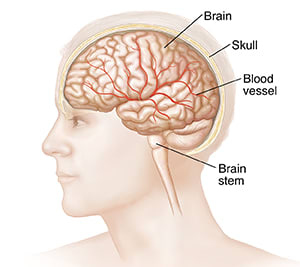
Types of TBI
A TBI can be mild, moderate, or severe. Most TBIs are mild. Some providers may refer to a mild TBI as a concussion. Other providers view concussion as a milder subset of TBI. If you have a mild TBI, you might be knocked out for a short time. Or you might just feel stunned for a while. With a moderate or severe TBI, you will be unconscious for longer. Your care team will decide how serious your TBI is based on the symptoms at the time of the trauma, as well as afterward. A tool called the Glasgow Coma Scale is often used to rate the severity of TBI. Symptoms of TBI are unpredictable. This means you could have a mild TBI and actually have symptoms that last longer than someone with a more severe TBI.
Types of damage
When the brain strikes the skull or twists on the brain stem, brain tissue tears. This injury may then cause a second type of damage, such as bleeding or swelling in the brain. Doctors try to control the second type of damage to help limit long-term problems.
Symptoms of TBI
Having a TBI can change your brain in many ways. A TBI can change the way you think, feel, act, and move. The symptoms depend on the part of your brain that is injured. Common symptoms of mild TBI may include:
- Headache.
- Confusion.
- Loss of consciousness.
- Dizziness.
- Blurry vision.
- Ringing in your ears.
- Feeling tired.
- Loss of memory.
- Mood or personality changes.
- Trouble sleeping.
- Being off balance.
- Being bothered by bright light.
- Feeling sick to your stomach (nausea).
Symptoms of moderate or severe TBI may include all the symptoms of a mild TBI. And they also may include:
- Extended loss of consciousness.
- A severe headache that doesn't go away.
- Repeated vomiting.
- Seizures.
- Extreme sleepiness.
- Slurred speech.
- Weakness and numbness in your arms and legs.
- Being very clumsy.
- Being very irritable, restless, or confused.
Recovering from TBI
Most people recover fully from a mild TBI. It may take days or weeks. If you have had more than one TBI, your recovery may take longer. Everyone's brain is different. So your recovery time and treatments will depend on how your brain is healing. Here are some tips to help your recovery:
- Be honest with your care team. Let them know about all your symptoms.
- Let your doctor know right away if your symptoms are getting worse or new symptoms appear.
- Keep all your appointments and follow your doctor's instructions carefully.
- Give your brain time to heal. Be patient and get plenty of rest.
- Don't smoke, take drugs, or drink alcohol.
- Don't take any medicines without checking with your doctor first. This includes over-the-counter medicines.
- Talk with your doctor if you have problems managing your emotions, such as laughing and crying uncontrollably. The provider might advise that you take a new medicine.
Recovery from a TBI is unpredictable and is different for each person. Many people can recover fully from a TBI, especially if it is mild. Remember that a TBI can change the way you think, feel, move, and act. The best way to recover is to let your family and care team know about all your symptoms. Work closely with your care team and give your brain time to heal.
Author: Illiades, Christopher
Online Medical Reviewer: Anne Fetterman RN BSN
Online Medical Reviewer: Joseph Campellone MD
Online Medical Reviewer: Raymond Kent Turley BSN MSN RN
Date Last Reviewed: 09/01/2025
© 2000-2026 The StayWell Company, LLC. All rights reserved. This information is not intended as a substitute for professional medical care. Always follow your healthcare professional's instructions.
Related Articles
Understanding Skull Base Tumors
The skull base offers support from the bottom. Think of it as the floor of the skull, where the brain sits. Tumors can form at the base of the skull.
What Is a Mild Traumatic Brain Injury (Concussion)?
A mild traumatic brain injury, or concussion, changes the way your brain works for a short time. Learn more about this condition.
What the Brain Does
Each part of your brain has a different role. The brain controls your breathing, heart rate, digestion, temperature regulation, your 5 senses, and movement. The brain also allows you to think, handle emotions, and make judgments among many other critical functions.
Understanding the Brain
The brain controls the entire body, from regulating breathing and blood pressure to enabling you to move and speak.


