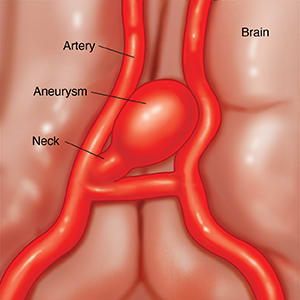
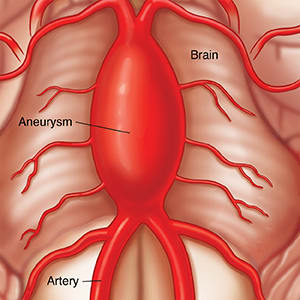
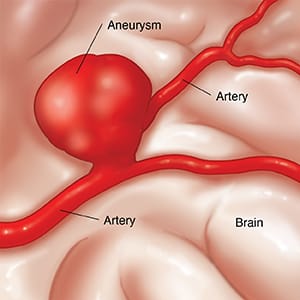
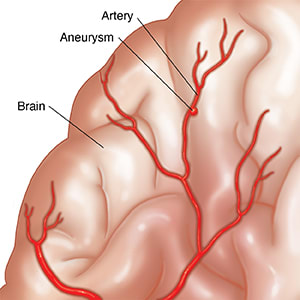
There are several types of brain aneurysms that are classified by shape. These are saccular (also called berry) aneurysms, which are by far the most common. Less common are the fusiform and dissecting types. Brain aneurysms may also be classified by:
- Size (small, large, and giant)
- Location
- Cause (such as a mycotic aneurysm, caused by an infection)
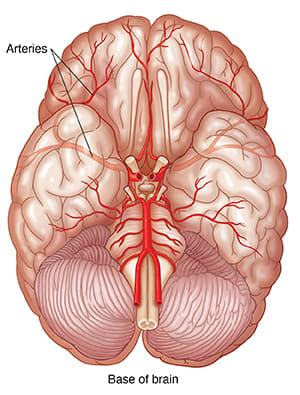
Most aneurysms occur where an artery branches, often at the base of the brain. The risk of an aneurysm bursting (rupturing) can be affected by the shape and location of the aneurysm. The treatment choices vary, depending on the type of aneurysm, its size, and its location.
Online Medical Reviewer: Chris Southard RN
Online Medical Reviewer: Marianne Fraser MSN RN
Online Medical Reviewer: Melinda Murray Ratini DO
Date Last Reviewed: 03/01/2024
© 2000-2026 The StayWell Company, LLC. All rights reserved. This information is not intended as a substitute for professional medical care. Always follow your healthcare professional's instructions.
Related Articles
Charcot-Marie-Tooth Disease
Charcot-Marie-Tooth disease is an inherited nerve defect that causes abnormalities in the nerves that supply your feet, legs, hands, and arms.
Understanding Functional Movement Disorders (FMD)
A functional movement disorder (FMD) is a problem with body movement that doesn’t have a clear physical cause, such as nerve damage.
Understanding Sixth Nerve Palsy
Sixth nerve palsy is a problem with eye movement. It happens because of a problem with the sixth cranial nerve, also called the sixth nerve.
Polymyositis
Polymyositis is a disease that causes muscles to become irritated and inflamed. The muscles eventually start to break down and become weak. The condition can affect muscles all over the body. It can make even simple movements hard to do.


