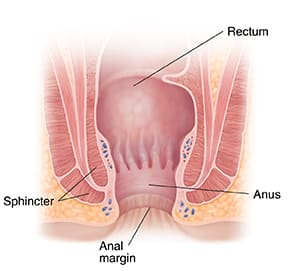
The anus is the last part of the digestive tract. It's at the end of the rectum. It's where stool comes out of the body. It consists of a muscular ring (called a sphincter) that opens during a bowel movement to allow stool (feces) to pass through and flat cells that line the inside of the anus. Most anal cancers start in these flat lining cells. These are also called squamous cells. The lower part of the anus, where it meets the skin, is called the anal margin.
Date Last Reviewed: 04/01/2023
© 2026 The StayWell Company, LLC. All rights reserved. This information is not intended as a substitute for professional medical care. Always follow your healthcare provider's instructions.
Related Articles
Ileostomy: Changing Your Pouch
Read on for step-by-step directions on how to change your ileostomy pouch.
Abdominal Ultrasound
Abdominal ultrasound is an imaging test that uses sound waves to form pictures of your abdominal organs. It can help detect organ problems, such as gallstones, kidney stones, or liver disease.
The Pancreas: Anatomy and Functions
Detailed anatomical description of human pancreas, including simple definitions and labeled, full-color illustrations
Ileostomy: Dealing with a Food Blockage
After an ileostomy, it may be harder to digest foods that are high in fiber. Eaten in large amounts, these foods can clump together and cause a blockage. Learn about the signs of a blockage and what to do if you have one.


