With gastrostomy tube feeding, you need to keep the tube from getting clogged. You do this by flushing it with warm water after each feeding and before and after giving any medicines.
There are different types of gastrostomy feeding tubes. One type has a connection that lets you plug or push the syringe into the feeding tube port. A newer type has a twist-on safety connector. The twist-on safety connector means you must use a specific type of syringe that twists onto your feeding tube port. Check with your care team to make sure you are following the steps for your specific type of gastrostomy tube. Ask for written gastrostomy tube instructions. Review the material with a care team member before you leave the hospital. Don't hesitate to ask questions and take notes. Have the information repeated as many times as needed until it's clear to you.
Wash your hands with soap and water before and after handling the feeding tube.
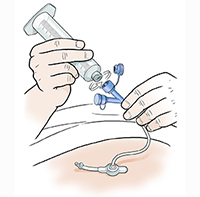
Plug-in syringe and tube
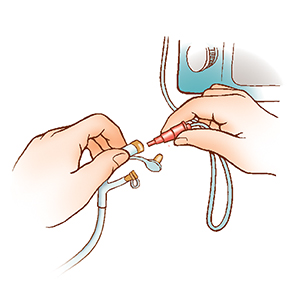
Twist-on syringe and tube
For continuous feeding
Flush the feeding tube with warm water and a clean the syringe before the first daily feeding, after the last daily feeding, and other times as instructed. Follow the steps below:
-
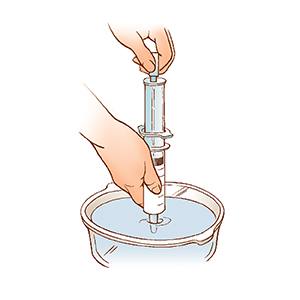
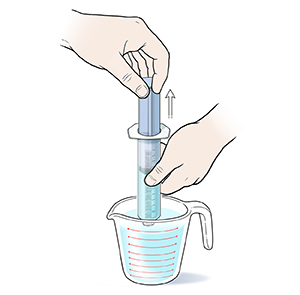
Fill a clean bowl with warm water.
-
Put the tip of the syringe in the water.
-
Draw up
15 to 30 cc (mL) of water. Follow your provider's specific instructions. The exact amount of water to use will vary depending on your age, condition, and situation. -
Turn off the pump.
-
Close the clamp on the feeding bag tubing.
-
Remove the tubing from the port.
-
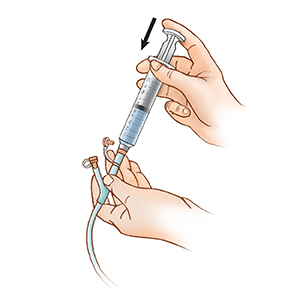
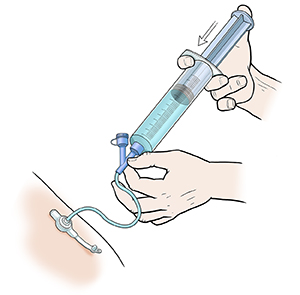
Put the tip of the syringe in the feeding port.
-
Plug-in port. If you have a plug-in feeding tube port, push the tip of the syringe into the feeding tube port.
-
Twist-on port. If you have a twist-on feeding tube port, screw the syringe tip onto your feeding port.
-
-
Push the plunger down.
-
Let the water run through the feeding tube.
-
Start the feeding or close the cap on the feeding port.
-
Tape the tube to the skin with medical tape.
Plug-in syringe and tube
Twist-on syringe and tube
For bolus feeding
You may be told to flush the feeding tube before and after each feeding, or just after feedings. Use a clean syringe and warm water. Follow the steps below:
-
Fill a clean bowl with warm water.
-
Put the tip of the syringe in the water.
-
Draw up ____ cc (mL) of water. (Tap water is okay to use.) Follow your provider's specific instructions. The exact amount of water to use will vary depending on your age, condition, and situation.
-
Open the cap on the feeding port.
-
Put the tip of the syringe in the feeding port.
-
Plug-in port. If you have a plug-in type feeding tube port, push the tip of the syringe into the feeding tube port.
-
Twist-on port. If you have a twist-on feeding tube port, screw the syringe tip onto your feeding port.
-
-
Push down on the plunger. Let the water run through the tube.
-
Close the cap.
-
Tape the tube to the skin with medical tape.
Online Medical Reviewer: Daphne Pierce-Smith RN MSN
Online Medical Reviewer: Melinda Murray Ratini DO
Online Medical Reviewer: Vinita Wadhawan Researcher
Date Last Reviewed: 11/01/2024
© 2000-2026 The StayWell Company, LLC. All rights reserved. This information is not intended as a substitute for professional medical care. Always follow your healthcare professional's instructions.
Related Articles
Ileostomy: Changing Your Pouch
Read on for step-by-step directions on how to change your ileostomy pouch.
Stoma Care: How to Irrigate
Here are images that show the steps for irrigating your stoma.
Feeding Tube Replacement With Foley Catheter
Your feeding tube has been replaced with a Foley catheter. Here's how to care for yourself at home.
Ileostomy: Dealing with a Food Blockage
After an ileostomy, it may be harder to digest foods that are high in fiber. Eaten in large amounts, these foods can clump together and cause a blockage. Learn about the signs of a blockage and what to do if you have one.


