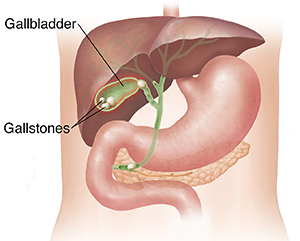
Biliary colic is pain in the upper region of the abdomen caused by gallstones. The gallbladder is a small sac under the liver that stores and releases a bile. Bile is a fluid made in the liver that helps your body digest fat. Crystals may form stones inside the gallbladder (gallstones). Gallstones can cause the gallbladder to spasm. If they block the duct out of the gallbladder, they can cause pain and even an infection.
A number of things increase the risk of having gallstones:
-
Being female
-
Being severely overweight (obese)
-
Older age
-
Losing or gaining weight quickly
-
Eating a high-calorie diet
-
Being pregnant
-
Taking hormone therapy
-
Having diabetes
Home care
-
Rest in bed.
-
Drink only clear liquids until you feel better.
-
You may have been prescribed medicine for pain or nausea. Take these as directed.
-
Fat in your diet makes the gallbladder contract and may cause increased pain. Don't eat foods that are high in fat, such as full-fat dairy, fried foods, and fatty meats for at least 2 days.
-
If you are overweight, talk with your healthcare provider about losing weight.
Follow-up care
Follow up with your healthcare provider or as advised. You may have another bout of pain from your gallstones at some point. Removal of the gallbladder is a choice to prevent this. Talk with your healthcare provider about your treatment choices.
When to get medical advice
Call your healthcare provider if any of the following occur:
-
Pain gets worse or lasts for longer than 6 hours
-
Pain moves to the right lower belly
-
Repeated vomiting
-
Swollen belly
-
Fever of 100.4ºF (38ºC) or higher, or as directed by your healthcare provider
-
Very dark urine, light colored stools, or yellow color of the skin or eyes
-
Chest, arm, back, neck, or jaw pain
-
Symptoms get worse or you have new symptoms
Online Medical Reviewer: Heather M Trevino BSN RNC
Online Medical Reviewer: Rajadurai Samnishanth Researcher
Online Medical Reviewer: Robyn Zercher FNP
Date Last Reviewed: 09/01/2024
© 2000-2026 The StayWell Company, LLC. All rights reserved. This information is not intended as a substitute for professional medical care. Always follow your healthcare professional's instructions.
Related Articles
H. Pylori Infection with Peptic Ulcer
A peptic ulcer is an open sore in the lining of the stomach or duodenum. In many cases, bacteria called H. pylori are thought to be involved in the development of a peptic ulcer.
Cancer Care: Controlling Nausea and Vomiting
Nausea and vomiting are common side effects of chemotherapy and radiation therapy. Here are some helpful tips.
Understanding Norovirus
Norovirus is a virus that can infect the stomach and intestines. The virus spreads easily in areas of close human contact, such as schools and cruise ships.
Understanding Intestinal Obstruction
An intestinal obstruction means that the small or large intestine is blocked at one or more spots. This prevents air, food, stool, and fluid from passing normally through the digestive system.


