Ulcers are sores in the lining of your digestive tract. They were once thought to be caused by too much spicy food, stress, or anxiety. It's now known that most ulcers are likely due to infection with bacteria known as Helicobacter pylori ( H. pylori). They could also be from using anti-inflammatory medicines, such as aspirin and other nonsteroidal anti-inflammatory drugs. These include ibuprofen and naproxen.
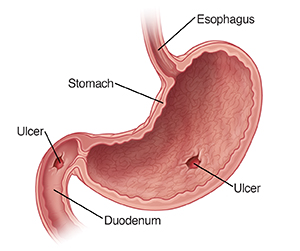
Common ulcer symptoms
Symptoms include:
-
Burning, cramping, or hunger-like pain in the stomach area, often 1 to 3 hours after a meal or in the middle of the night.
-
Pain that gets better or worse with eating.
-
Upset stomach (nausea) or vomiting.
-
Black, tarry, or bloody stools. (This means the ulcer is bleeding.)
Some people have no symptoms.
Your evaluation
An evaluation by your health care provider can show if you have an ulcer and find out if it was caused by H. pylori . Your provider may ask you questions, examine you, and possibly do some tests. These may include:
-
Upper GI series. This is a special X-ray that's done to help locate an ulcer. Before the test, you drink a chalky liquid, called barium. This liquid helps the ulcer show up on the X-ray.
-
Endoscopic exam. This test is done with a long tube with a camera on the end. The tube is passed through your mouth into your stomach, and allows the provider to get a closer look at your ulcer. You'll be lightly sedated for this procedure. Your provider can also take a tissue sample to test for H. pylori .
-
Other tests. Blood, stool, and breath tests may also be done to show if you have H. pylori in your digestive tract.
Your treatment
To treat the H. pylori bacteria so your ulcer can heal, your health care provider will likely prescribe antibiotics. Other ulcer medicines that help reduce stomach acid may also be prescribed as well. Testing after treatment may be advised to be sure the H. pylori infection is gone. Usually, treating the H. pylori infection helps prevent the ulcer from returning. But you can have ulcers more than once in your lifetime.
Online Medical Reviewer: Jen Lehrer MD
Online Medical Reviewer: Rita Sather RN
Online Medical Reviewer: Robyn Zercher FNP
Date Last Reviewed: 01/01/2025
© 2000-2026 The StayWell Company, LLC. All rights reserved. This information is not intended as a substitute for professional medical care. Always follow your healthcare professional's instructions.
Related Articles
What Is a Hiatal Hernia?
This common problem occurs when part of the stomach slides up through the diaphragm into the chest cavity. Hiatal hernias aren't like hernias in your groin. Most hiatal hernias cause no symptoms and need no treatment. If you notice symptoms, usually you can control them easily.
Understanding Pancreatitis
If your pancreas suddenly becomes irritated or inflamed, you have acute pancreatitis. Acute pancreatitis is often very painful. Emergency medical treatment is usually needed.
Cholecystitis (Presumed)
Find out about cholecystitis, an inflammation and infection of the gallbladder. Learn how it's treated and how to care for yourself at home.
What Is Irritable Bowel Syndrome (IBS)?
People who have irritable bowel syndrome (IBS) have digestive tracts that react abnormally to certain substances or to stress. This leads to symptoms like cramps, gas, bloating, pain, constipation, and diarrhea.


