What is tonsillitis?
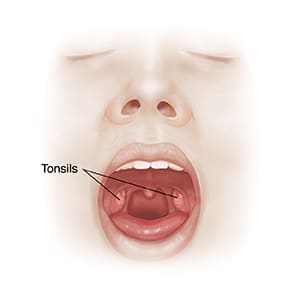
Tonsillitis means that your tonsils are inflamed. Your tonsils are large, fleshy glands at the back of your throat. These glands make antibodies that help fight infection.
What causes tonsillitis?
Both bacteria and viruses can cause tonsillitis. They include:
- Streptococcus, or strep, bacteria. These germs are the most common cause.
- Adenoviruses.
- Epstein-Barr virus, which causes infectious mononucleosis.
- Herpes simplex virus.
- Cytomegalovirus.
- Measles virus.
These germs are often easily passed from one person to another (contagious).
What are the symptoms of tonsillitis?
Each person may have slightly different symptoms. The most common symptoms of tonsillitis include:
- Swollen, red tonsils. They may look yellow, gray, or white.
- Blisters or painful sores on the throat.
- Sore throat that happens suddenly.
- Pain when swallowing, or hard to swallow.
- Snoring.
- Bad breath.
- Headache.
- Loss of appetite.
- Tiredness.
- Chills.
- Fever.
- Swollen and sore lymph nodes in the neck or jaw area.
You may not have any symptoms but still have the strep bacteria. You can pass these bacteria on to another person.
A complication of tonsillitis is an area around the tonsils filled with bacteria. This is called a peritonsillar abscess. You may have these symptoms:
- Severe throat pain
- Muffled voice
- Drooling
- Trouble opening mouth
The symptoms of tonsillitis may look like other conditions or health problems. Always see your doctor for a diagnosis.
How is tonsillitis diagnosed?
Your doctor will ask about your health history and do a physical exam. Your doctor may do a strep test if they think the infection is caused by strep bacteria. Or your doctor may do this test to rule out strep as the cause. To do this test, your doctor will take a swab of your tonsils.
How is tonsillitis treated?
Treatment will depend on your symptoms, age, and general health. It will also depend on how severe the condition is.
Tonsillitis caused by a virus is treated differently from tonsillitis caused by bacteria. Your doctor may give you antibiotic medicine for tonsillitis caused by bacteria. They may give you antiviral medicine to treat tonsillitis caused by a virus.
If your tonsillitis comes back again and again, your doctor may advise surgery to remove your tonsils.
You may need treatment right away if you develop a peritonsillar abscess. This is because the abscess may block your airway.
What can I do to prevent tonsillitis?
No vaccine or medicine can prevent tonsillitis. These tips can help keep you from spreading an illness that can cause tonsillitis:
- Keep away from anyone with tonsillitis or a sore throat.
- Don't share utensils, drinking glasses, toothbrushes, or other personal objects with anyone who has tonsillitis or a sore throat.
- Wash your hands often.
- Cover your mouth when you cough or sneeze.
Key points about tonsillitis
- Tonsillitis means that your tonsils are inflamed.
- Both bacteria and viruses can cause tonsillitis. These are often easily passed from one person to another.
- Tonsillitis caused by a virus is treated differently from tonsillitis caused by bacteria.
- You can help prevent tonsillitis by washing your hands often. You should also stay away from anyone with a sore throat or tonsillitis.
- You will need treatment right away if you develop a peritonsillar abscess. This can block your airway.
Next steps
Tips to help you get the most from a visit to your doctor:
- Know the reason for your visit and what you want to happen.
- Before your visit, write down questions you want answered.
- Bring someone with you to help you ask questions and remember what your doctor tells you.
- At the visit, write down the name of a new diagnosis and any new medicines, treatments, or tests. Also write down any new directions your doctor gives you.
- Know why a new medicine or treatment is prescribed, and how it will help you. Also know what the side effects are.
- Ask if your condition can be treated in other ways.
- Know why a test or procedure is recommended and what the results could mean.
- Know what to expect if you do not take the medicine or have the test or procedure.
- If you have a follow-up appointment, write down the date, time, and purpose for that visit.
- Know how you can contact your doctor if you have questions.
Date Last Reviewed: 09/01/2025
© 2000-2026 The StayWell Company, LLC. All rights reserved. This information is not intended as a substitute for professional medical care. Always follow your healthcare professional's instructions.
Related Articles
Anatomy and Physiology of the Nose and Throat
A helpful guide to the nose, the sinuses, and the throat.
Ear, Nose, and Throat Facts
Read on for a detailed look at the parts that make up the ear, nose, and throat.
Sinusitis
Sinusitis is an infection of the lining of the sinuses near the nose. These infections most often happen after a cold or after an allergy flare-up.
The Middle Ear
The middle ear is an air-filled chamber that lies behind the eardrum. Pressure in the middle ear changes to match air pressure outside of the eardrum. When inside and outside pressures are balanced, the eardrum is flexible and normal hearing is more likely. Problems happen when air pressure in the middle ear drops. This is often due to a block in the eustachian (u-STA-shun) tube, the narrow channel connecting the ear with the back of the throat.


