Aspiration is when something enters the airway or lungs by accident. It may be food, liquid, or some other material. This can cause serious health problems, such as pneumonia. Aspiration can happen with these 2 conditions:
-
Dysphagia. A person has trouble swallowing normally.
-
GERD (gastroesophageal reflux disease). Stomach contents come back up into the throat.
What happens when your child swallows
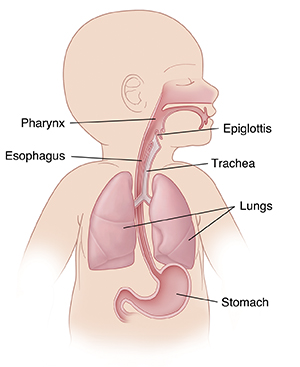
When your child swallows food, it passes from the mouth down into the throat. This is called the pharynx. From there, the food moves down through a long tube (esophagus) and into the stomach. This journey is made possible by a series of actions from the muscles in these areas. If your child has dysphagia, the muscles don’t work normally. They cause problems with swallowing.
The pharynx is also part of the system that brings air into the lungs. When a person breathes, air enters the mouth and moves into the pharynx. The air then goes down into the main airway (trachea) and into the lungs. A flap of tissue called the epiglottis sits over the top of the trachea. This flap blocks food and drink from going down into the trachea when your child swallows. But in some cases, food or drink can enter the trachea. It may go down as your child swallows. Or it may come back up from the stomach. A child with dysphagia is much more likely to aspirate. A child with a developmental or health problem is more likely to have dysphagia.
What causes aspiration
Some conditions can increase a child’s risk for aspiration, such as:
-
Stomach contents coming back up into the throat (GERD).
-
Abnormal anatomy, such as a cleft palate or a problem in the esophagus.
-
Delayed growth, from premature birth or a condition, such as Down syndrome.
-
Brain damage or other problems, such as from cerebral palsy or infection.
-
Problems with the cranial nerves that control the muscles of swallowing.
-
Neuromuscular disease, such as spinal muscular atrophy.
-
Medical procedures, such as a nasogastric tube or a tracheostomy.
Symptoms of aspiration
Aspiration can cause signs in a baby, such as:
-
Weak sucking.
-
Choking or coughing while feeding.
-
Other signs of feeding trouble, such as a red face, watery eyes, or facial grimaces.
-
Stopping breathing while feeding.
-
Faster breathing while feeding.
-
Voice or breathing that sounds wet after feeding.
-
Slight fever after feedings.
-
Wheezing and other breathing problems.
-
Repeated lung or airway infections.
Aspiration can cause symptoms in an older child, such as:
-
Choking or coughing while eating.
-
Voice that sounds wet after eating.
-
Slight fever after meals.
-
Complaints of food feeling stuck or coming back up.
-
Wheezing and other breathing problems.
-
Repeated lung or airway infections.
Symptoms can happen right after eating. Or they may happen over time. Your child may not have all of these symptoms. The symptoms may depend on the age of your child, and how often and how much your child aspirates.
Some children who aspirate don't have any signs or symptoms. This is called silent aspiration.
Diagnosing aspiration
Your child will need to be checked for aspiration if they have:
-
Any symptoms of aspiration.
-
Health problem that can cause trouble swallowing.
-
GERD.
The doctor will ask about your child’s health history and symptoms. This may be done by a speech-language pathologist (SLP). The SLP may ask about what foods or drink cause problems, and when your child’s symptoms occur. They may want to watch your child during a feeding.
Your child may also need tests. These can check for problems. They can also show if food and fluid is going into your child’s lungs. The tests may include:
-
Chest X-ray or CT scan.
-
Modified barium swallow test .
-
Fiberoptic endoscopic evaluation of swallowing.
-
Nuclear medicine scans.
Featured in
Online Medical Reviewer: Jessica Gotwals BSN MPH
Online Medical Reviewer: Liora C Adler MD
Online Medical Reviewer: Marianne Fraser MSN RN
Date Last Reviewed: 02/01/2025
© 2000-2026 The StayWell Company, LLC. All rights reserved. This information is not intended as a substitute for professional medical care. Always follow your healthcare professional's instructions.
Related Articles
Ear Tubes for Children (Tympanostomy)
Ear tubes are small tubes that are placed in your child’s eardrum by an ear, nose, and throat surgeon. The tubes help to drain the fluid out of the middle ear. Read on to learn more.
Dermoid Cyst in Children
A dermoid cyst is a collection of tissue under the skin. It may contain hair follicles, oil, and sweat glands.
Overview of Neck Masses in Children
Detailed information on neck masses in children.
Pharyngitis and Tonsillitis in Children
Pharyngitis is redness, pain, and swelling of the throat, and tonsillitis is inflammation of the tonsils. Learn more about these conditions in children, including causes, symptoms, and treatment.


