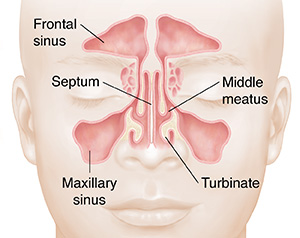
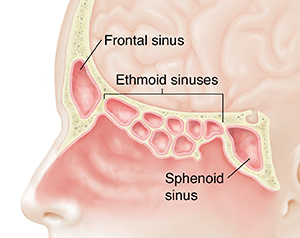
Your sinuses are air-filled spaces between the bones in your head. They have small openings that connect to the nasal cavity. The sinuses make mucus that drains into the nose. This helps keep the nose moist and free of dust and germs.
Parts of the nasal cavity
-
The septum is the wall of cartilage and bone in the center of the nasal cavity.
-
The middle meatus is the intersection between the sinuses.
-
Turbinates are ridges on the sides of the nasal cavity.
Cilia keep sinuses clear
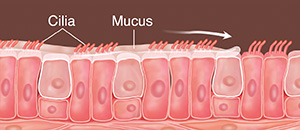
Air circulates freely though healthy sinuses. Tiny, hairlike structures called cilia line the sinuses. Cilia move the thin, watery mucus through the sinuses and into the nose. Sinuses are healthy when they drain freely. Sinus drainage can be blocked if the sinus lining is swollen or if mucus is too thick. Cilia that are damaged or don’t work correctly can also lead to problems with drainage.
Online Medical Reviewer: Ashutosh Kacker MD
Online Medical Reviewer: Daphne Pierce-Smith RN MSN CCRC
Online Medical Reviewer: Marianne Fraser MSN RN
Date Last Reviewed: 08/01/2023
© 2000-2026 The StayWell Company, LLC. All rights reserved. This information is not intended as a substitute for professional medical care. Always follow your healthcare professional's instructions.
Related Articles
Labyrinthitis
When the inner ear gets irritated or inflamed it causes a condition known as labyrinthitis. This causes sudden dizziness and balance problems.
Ruptured Eardrum, Traumatic
A ruptured eardrum will cause pain. There may be some clear or bloody drainage. A buzzing sound may be heard in the ear. Some hearing may be lost the affected ear.
Benign Paroxysmal Positional Vertigo
This is a common condition. You feel as if the room is spinning after changing position, moving your head quickly, or even just rolling over in bed.
Sinus Headache
Learn how to care for a sinus headache at home.


