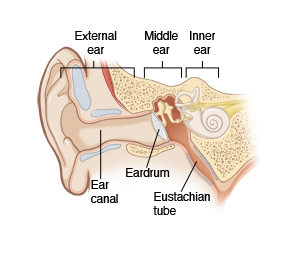
Vertigo is a false feeling of motion. You aren't moving, but it feels as if you are. This feeling can be caused by problems in the inner ear. In addition to helping with hearing, the inner ear is part of the balance center of your body. When something affects the balance center, you can have vertigo. Often it feels as if you or the room are spinning. A vertigo attack may cause sudden nausea and vomiting. You may suddenly fall to the ground (drop attack). During vertigo, small head movements and changes in body position will often make the symptoms worse. You may also have ringing in the ears (tinnitus).
An episode of vertigo may last seconds, minutes, or hours. Once you are over the first episode, it may never come back. But symptoms may return off and on. Often your provider will have you do certain head and body movements in the office to treat your vertigo.
The cause of your vertigo is not yet known. Possible causes of vertigo include:
-
Inner ear inflammation.
-
Disease of the nerves to the inner ear.
-
Movement of calcium particles in the inner ear.
-
Poor blood flow to the balance centers of the brain.
-
Migraine headaches.
-
Certain medicines.
Home care
-
If symptoms are severe, rest quietly in bed. Change positions very slowly. There is often one position that will feel best. This may be lying on one side or lying on your back with your head slightly raised on pillows. Until you have no symptoms, you are at a higher risk of falling. Let someone help you when you get up. Get rid of home hazards such as loose electrical cords, clutter, toys on the floor, and throw rugs. Don’t walk in unfamiliar areas that are not lighted. Use night-lights in bathrooms and kitchens.
-
Don't drive a car or work with dangerous machinery until symptoms have been gone for at least 1 week or until your doctor says it's safe.
-
Take medicine as prescribed to ease your symptoms. Unless another medicine was prescribed for symptoms of nausea, vomiting, and dizziness, you may use over-the-counter motion sickness pills. Before taking new medicines, talk with your doctor about any possible side effects. Let your pharmacist know all of the other medicines you are taking and if you have any allergies to medicines.
Follow-up care
Follow up with your doctor as directed. If you are referred to a specialist or for testing, make the appointment right away.
When to get medical advice
Contact your doctor if you have:
-
A fever of 100.4°F (38ºC) or higher, or as directed by your doctor.
-
Vertigo that gets worse or is not controlled by prescribed medicine.
-
Repeated vomiting that doesn't stop after taking prescribed medicine.
-
A severe headache.
-
Confusion.
-
Trouble with vision.
Call 911
Call 911 if you:
-
Fainted (lost consciousness).
-
Have a seizure.
-
Have weakness of an arm, leg, or one side of the face.
-
Have trouble with speech.
Online Medical Reviewer: Ashutosh Kacker MD
Online Medical Reviewer: Marianne Fraser MSN RN
Online Medical Reviewer: Tara Novick BSN MSN
Date Last Reviewed: 06/01/2025
© 2000-2026 The StayWell Company, LLC. All rights reserved. This information is not intended as a substitute for professional medical care. Always follow your healthcare professional's instructions.
Related Articles
Labyrinthitis
When the inner ear gets irritated or inflamed it causes a condition known as labyrinthitis. This causes sudden dizziness and balance problems.
Pharyngeal Abrasion
You (or your child) has an abrasion (scratch) on the back of the throat. Learn how to care for this condition at home.
Understanding Your Sinuses
Your sinuses are air-filled spaces between the bones in your head. The sinuses make mucus that drains into the nose. This helps keep the nose moist and free of dust and germs.
Benign Paroxysmal Positional Vertigo
This is a common condition. You feel as if the room is spinning after changing position, moving your head quickly, or even just rolling over in bed.


