Sharp vision depends on many factors. The parts of the eye work together to bend (refract) and focus light rays. For normal vision, light must focus onto the retina.
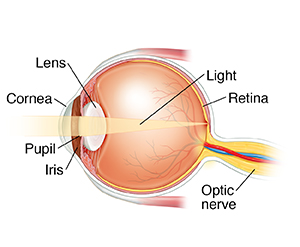
Cornea
Light enters the eye through this clear, dome-shaped tissue that covers the front of the eye. The cornea bends light rays to help focus them. Problems with its shape can affect vision.
Pupil
This circular window in the center of the iris opens and closes to let the right amount of light into the eye.
Iris
This is the colored part of the eye. It contains muscles that open (dilate) and close (constrict) the pupil.
Lens
This disk of clear tissue behind the pupil changes shape to help focus light.
Retina
This thin layer of light-sensitive tissue lines the inside back of the eye. It sends images as electrical impulses to the optic nerve.
Optic nerve
This nerve carries signals from the retina to the brain. The brain then interprets these signals to make images. These images are what you see.
Online Medical Reviewer: Chris Haupert MD
Online Medical Reviewer: Raymond Kent Turley BSN MSN RN
Online Medical Reviewer: Rita Sather RN
Date Last Reviewed: 08/01/2022
© 2000-2026 The StayWell Company, LLC. All rights reserved. This information is not intended as a substitute for professional medical care. Always follow your healthcare professional's instructions.
Related Articles
Common Eye Disorders
One common eye disorder is conjunctivitis, sometimes called pink eye. It's an inflammation of the blood vessels in the eye membrane. Another common disorder is a chalazion—a small bump that develops on the upper or lower eyelid.
Anatomy of the Eye
The structures of the eye include the cornea, iris, pupil, macula, retina, and the optic nerve.
Sixth Nerve Palsy
Sixth nerve palsy occurs when the sixth cranial nerve is damaged or doesn't work right. It's also known as the abducens nerve. This condition causes problems with eye movement.
What Is Uveitis?
Uveitis is a serious eye problem. Left untreated, it can lead to other conditions, such as glaucoma, and even vision loss. Here's what you should know about possible causes and symptoms.


