YAG capsulotomy is done in your eye care provider’s office or at an outpatient surgery center. The treatment is often quick and painless. You can often return to your normal routine right away. There are no needles or stitches. There is no risk of infection. Your vision will likely be fully restored soon after treatment.
Possible risks
Laser treatment is safe. But all procedures have some risks. The risks of this treatment include:
-
Your eye pressure may rise, often only for a short time.
-
The laser can scratch your IOL (intraocular lens). But this almost never affects vision.
-
In rare cases, you may experience an increase in floaters or the retina may become detached.
Before capsulotomy
Ask your eye care provider if you need to have someone drive you to and from your treatment. Most people see clearly again right away and go home shortly after treatment.
During capsulotomy
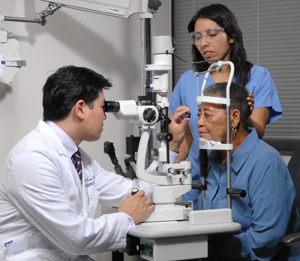
First, your eye is numbed and your pupil is enlarged (dilated) with eye drops. Then you rest your chin on a chin rest on the laser machine. You may see flashes of light and hear a faint clicking sound as the laser enters your eye. But you should not feel any pain. You can help by staying relaxed and still.
After capsulotomy
You should begin to see better in 24 hours. Your eye care provider may check your eye pressure later that day or the next. They may also give you eye drops or an ointment. Once the laser makes an opening in the part of the eye that holds the lens in place (the posterior capsule), it allows light to pass through again. This improves your vision.
When to call your eye care provider
Call your eye care provider right away if you have any of the following:
-
More pain
-
Sudden decrease in vision
-
More flashing lights or floaters
-
A shadow covering your vision
Online Medical Reviewer: Chris Haupert MD
Online Medical Reviewer: Tara Novick BSN MSN
Online Medical Reviewer: Whitney Seltman MD
Date Last Reviewed: 09/01/2025
© 2000-2026 The StayWell Company, LLC. All rights reserved. This information is not intended as a substitute for professional medical care. Always follow your healthcare professional's instructions.
Related Articles
Treating Retinal Tears and Detachments
Depending on your retinal damage, your eye care provider may use 1 or more procedures to treat the problem. Some treatments can be done in your eye care provider's office. Others need surgery in a hospital or surgery center.
Particle Removed From Eye With Rust Ring (Corneal Foreign Body)
If a metal particle gets into the eye, tears can cause the metal to rust and form a stain on the cornea. This can last even after the particle is removed.
YAG Capsulotomy: How a YAG Laser Works
Find out how a YAG laser uses fast, tiny bursts of energy to improve your vision during a capsulotomy.
Ultraviolet Keratitis
Ultraviolet keratitis is when exposure to too much UV (ultraviolet) light hurts your cornea. This causes pain and affects your vision.


