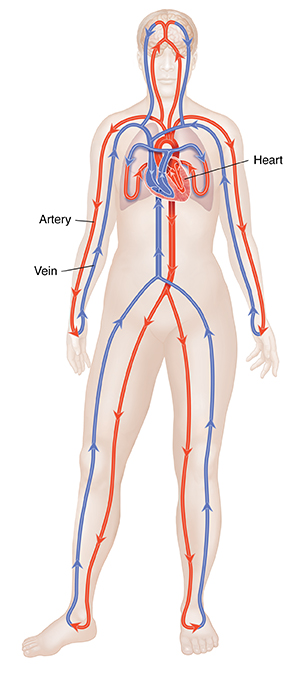
Blood flows from the heart to the body and back to the heart. This nonstop flow is called circulation. Blood flows through blood vessels. These are hollow muscular tubes. There are 3 main types of blood vessels:
-
Arteries carry oxygen-rich blood away from the heart.
-
Veins return oxygen-poor blood to the heart.
-
Capillaries are tiny blood vessels that connect arteries and veins. Capillaries have thin walls that let oxygen and nutrients pass through them to your body parts. They also allow waste products to move from your body parts to the blood.
Online Medical Reviewer: Anne Fetterman RN BSN
Online Medical Reviewer: Deepak Sudheendra MD
Online Medical Reviewer: Raymond Kent Turley BSN MSN RN
Date Last Reviewed: 04/01/2024
© 2000-2026 The StayWell Company, LLC. All rights reserved. This information is not intended as a substitute for professional medical care. Always follow your healthcare professional's instructions.

Related Articles
Orthostatic Low Blood Pressure (Hypotension)
Learn about orthostatic hypotension, including causes, symptoms, and how to care for yourself.
Low Blood Pressure, All Causes
Learn about the causes of low blood pressure and how to care for yourself at home when you have low blood pressure.
Discharge Instructions: Changing the Dressing on Your Central Line
Since a central line provides a direct path into your bloodstream, there is a high risk of infection when you change the dressing. Follow these step-by-step instructions to do this safely.
Understanding Deep Vein Thrombosis
DVT is a blood clot in a deep vein. To protect your health, a blood clot must be treated right away. Read on to learn about details such as how DVT occurs, risk factors, symptoms, treatment, and prevention.


