The electrocardiogram (ECG) is a test that records electrical signals from your heart. The pattern of these signals can help tell the healthcare provider if your heart is normal, under stress, or having electrical problems, changes in the heartbeat, strain, or other damage.
Getting ready
-
Wear loose, comfortable clothing that allows easy access to the chest.
-
Allow enough time before your ECG to check in. You'll likely need to fill out paperwork before the test.
What happens during an ECG
-
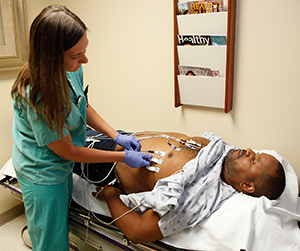
You'll be asked to remove your clothing from the waist up and to put on a gown. You'll then lie down on your back.
-
Electrodes (small pads) are placed on your chest, shoulders, and legs. If you have excess body hair that keeps the electrodes from making contact with your skin, small patches of hair may need to be shaved.
-
If your skin is moist or sweaty, it may have to be dried off for the small patches to stick to the skin.
-
The electrodes record your heart rhythm and any change in your heart’s signals that occur during the test.
-
After a few minutes of recording, the healthcare provider will remove the electrodes. In some cases, they may have to repeat the ECG to get accurate results. From start to finish, the ECG takes about
10 minutes.
What happens after the test
-
You can resume your normal activity.
-
The results are sent to your healthcare provider for interpretation.
-
Be sure to keep your follow-up appointment.
Your next appointment is:____________________
Tell your healthcare provider if you:
-
Are taking any medicines. This includes both over-the-counter and prescription medicines, vitamins, herbs, and other supplements. Also tell them if you're taking illegal drugs.
-
Feel any chest discomfort, pain, burning, tightness, or pressure
-
Feel as though your heart is beating rapidly or irregularly (palpitations)
-
Have ever blacked-out, fainted, or stopped being awake and aware
Online Medical Reviewer: Callie Tayrien RN MSN
Online Medical Reviewer: Stacey Wojcik MBA BSN RN
Online Medical Reviewer: Steven Kang MD
Date Last Reviewed: 04/01/2024
© 2000-2026 The StayWell Company, LLC. All rights reserved. This information is not intended as a substitute for professional medical care. Always follow your healthcare professional's instructions.

Related Articles
Having a Contrast Echocardiogram
A contrast echocardiogram helps your health care provider see how your heart is working. It uses ultrasound and a contrast fluid to help highlight the structures in the heart.
Coronary Angiography
Angiography is a special type of x-ray that allows your coronary arteries to be viewed and recorded on film. Your doctor can see if the blood vessels to your heart are clogged.
PET Scan
A PET scan can show changes in how an organ or tissue works. This can help your healthcare provider diagnose problems and create a treatment plan for you. Here's what to expect from this procedure.
Electrocardiogram
An electrocardiogram (ECG) is one of the simplest and fastest tests used to evaluate the heart. Electrodes (small, plastic patches that stick to the skin) are placed at certain locations on the chest, arms, and legs. When the electrodes are connected to an ECG machine by lead wires, the electrical activity of the heart is measured, interpreted, and printed out.


