Nitroglycerin eases chest pain (angina) by getting more blood and oxygen to your heart. It also reduces the heart's need for oxygen by dilating arteries. Fast-acting nitroglycerin can stop an angina attack. Follow the steps below for taking this medicine.
Note: Your health care provider may give you slightly different instructions. If so, follow them carefully. You can also take your nitroglycerin once to help prevent angina before you start doing activities that you know will bring on your angina.
To stop an angina attack
Sit down before you take your nitroglycerin. The medicine may make you feel dizzy because it lowers your blood pressure rapidly.
If you use tablets
-
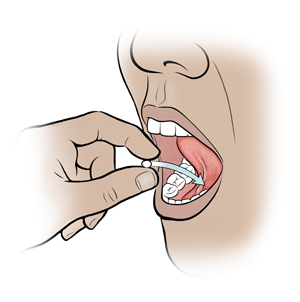
Place 1 tablet under your tongue. Or place it between your lip and gum. Or put it between your cheek and gum.
-
Let the tablet dissolve all the way. Don't swallow or chew the tablet.
-
Don't eat, drink, smoke, or chew tobacco as the tablet is dissolving.
If you use spray
-
Prime the pump before use.
-
Open your mouth and hold the sprayer just in front of your mouth.
-
Press the button on the top. Spray once on or under your tongue. Don't inhale.
-
Close your mouth. Then wait a few seconds before you swallow.
After taking 1 tablet or spraying once
-
Continue sitting for 5 minutes.
-
If the angina goes away completely, rest for a while. Then continue your normal routine.
Call 911
Call 911 if your angina lasts longer than 5 minutes and 1 tablet or 1 spray has not relieved it. Don't delay. You may be having a heart attack!
After you call
Precautions
-
Limit how much alcohol you drink. Too much alcohol can cause dizziness or fainting.
-
Tell your health care provider about any medicines, supplements, or herbs you use. Nitroglycerin can interact with other medicines. This can cause serious problems.
-
Don't take phosphodiesterase inhibitors, such as sildenafil (Viagra) or tadalafil (Cialis). These are medicines that help treat sexual function in men. The combination of nitroglycerin with these medicines can cause a severe drop in blood pressure. This can lead to dizziness, fainting, heart attack, or stroke.
-
Check when your medicine expires. Nitroglycerin can become less effective over time.
-
Keep some nitroglycerin with you at all times.
-
Keep nitroglycerin in its original container. Store in a dry place (not the bathroom) away from heat and light.
-
Tell your provider if your angina attacks last longer, occur more often, or are more severe.
Online Medical Reviewer: Callie Tayrien RN MSN
Online Medical Reviewer: Stacey Wojcik MBA BSN RN
Online Medical Reviewer: Steven Kang MD
Date Last Reviewed: 02/01/2025
© 2000-2026 The StayWell Company, LLC. All rights reserved. This information is not intended as a substitute for professional medical care. Always follow your healthcare professional's instructions.

Related Articles
Understanding Surgery for a Left Ventricular Assist Device
A left ventricular assist device (LVAD) helps the heart pump blood throughout your body. You may need surgery to get an LVAD if you have severe heart failure.
Minimally Invasive Bypass Surgery
Bypass surgery creates a new pathway around the blocked part of your artery. This allows blood to flow again.
Biventricular Pacemaker and ICD (Biventricular ICD)
You have a condition called heart failure. To treat your symptoms, you will get a special device to help keep your heart pumping normally.
Treatment for Pericardial Effusion
Pericardial effusion is the buildup of extra fluid in the sac around the heart (pericardium). If too much fluid builds up, it can put pressure on the heart and prevent it from pumping normally.