Percutaneous transcatheter treatment is a way to treat a deep vein thrombosis (DVT). DVT is a blood clot that forms in a large, deep vein. It happens most often in one of the veins of your legs. You may have pain, swelling, warmth, and redness from the DVT.
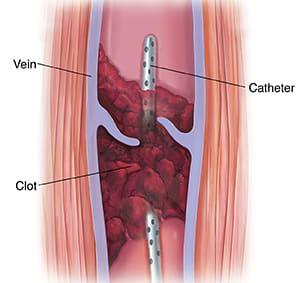
The treatment is done with a long, thin tube (catheter). The catheter is used to get to the blood clot to help remove it or break it up. Percutaneous means that it's done through a small cut (incision) in the skin. Your doctor may use the catheter with medicine, tools, or other tiny devices (balloons, wire mesh) to treat the clot.
Why percutaneous transcatheter treatment for DVT is done
When you have DVT, a piece of the blood clot may break off and go through your blood vessels to one of your lungs. This is a life-threatening condition called pulmonary embolism (PE). Percutaneous transcatheter treatment is done to remove the clot so this doesn't happen.
Your doctor may advise this treatment to:
- Treat DVT if blood-thinner medicine didn't work.
- Ease symptoms from DVT, such as swelling.
- Treat a blood clot in your thigh or pelvis, which is more likely to lead to serious problems.
- Treat a large blood clot.
- Lower the risk of long-term problems with your veins.
All treatments for DVT have their own risks and benefits. Ask your doctor which treatment is best for you.
How percutaneous transcatheter treatment of DVT is done
The procedure is done by a doctor who is a blood vessel (vascular) specialist. It can be done in several ways. They will make a small cut (incision) through your skin and into a blood vessel (vein) in your groin. The cut is made in the area between your stomach and your thigh. The doctor will put a long, thin wire into the incision. With X-ray guidance, they will position the wire near the clot. The doctor will then insert a catheter using the wire as a guide. They may then send clot-dissolving medicine through the catheter. They may use small tools to help break up the clot. A tiny balloon or mesh may be inserted to open the vein.
Risks of percutaneous transcatheter treatment of DVT
All treatments have risks. The risks of this procedure include:
- Too much bleeding.
- Infection.
- Damage to the vein.
- The clot breaking off and traveling to other areas or organs.
- A reaction to anesthesia.
- Another DVT forming.
Your risks vary depending on your overall health, how long you've had the clot, and where it is in your body. Ask your doctor which risks apply most to you.
Online Medical Reviewer: Anne Fetterman RN BSN
Online Medical Reviewer: Deepak Sudheendra MD
Online Medical Reviewer: Raymond Kent Turley BSN MSN RN
Date Last Reviewed: 09/01/2025
© 2000-2026 The StayWell Company, LLC. All rights reserved. This information is not intended as a substitute for professional medical care. Always follow your healthcare professional's instructions.

Related Articles
Peripheral Artery Bypass Surgery
Surgery to bypass a blocked leg artery can ease your symptoms. The bypass is done with a special tube that reroutes blood around a blockage.
Surgery for Abdominal Aortic Aneurysm
During surgery for abdominal aortic aneurysm, the weakened aortic wall is replaced with a hollow man-made tube (a graft).
Understanding Embolectomy
Embolectomy is surgery to remove a blood clot (embolus) from one of your blood vessels. It is often an emergency procedure.
Having Inferior Vena Cava (IVC) Filter Placement and Removal
An inferior vena cava (IVC) filter is a small device that can stop blood clots from going into your lungs.


