Atrial septal defect (ASD) is a heart condition that's present at birth (congenital). It's one of the most common congenital heart defects.
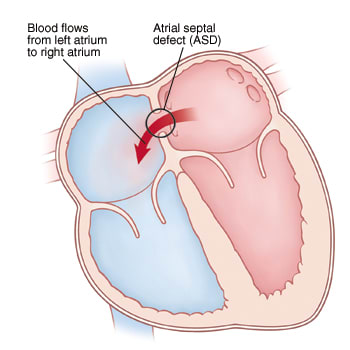
The heart has four chambers. With ASD there is a hole in the dividing wall (septum) between the two top chambers (atria) of the heart. Normally, this hole closes shortly after birth. Having this hole increases blood flow to the right side of the heart and to the lungs. This makes your heart and lungs work harder.
A small ASD may not cause any problems. And the hole may close on its own. But over time, a large ASD can harm your heart and lungs.
You may have been diagnosed with an ASD and possibly treated for it as a child, and want to follow up on it now as an adult. Or you may have just been diagnosed with an ASD as an adult.
What causes an atrial septal defect?
An ASD is a problem with the heart's structure that you are born with. It may be the only defect you have. Or it may be part of a more complex set of defects. No one knows the exact cause of ASD. In many cases it seems to happen by chance. But having a family history of heart defects can be a risk factor.
Why is ASD a problem?
Blood normally flows from chamber to chamber in one direction through the left and right sides of the heart. With an ASD, blood typically flows through the hole from the left atrium to the right atrium. This causes more blood than normal to pass through the right side of the heart. Extra blood has to be pumped by the right side of the heart to the lungs. This overworks the right side of the heart and creates too much blood flow to the lungs. If not treated, over time it can lead to high blood pressure in the lungs and to right-sided heart failure.
Pregnancy and ASD
Women with an ASD are advised to see a cardiologist before getting pregnant. This is to assess heart function and any risk. In most cases, a small or fixed ASD won't cause any problems. But there is still some risk for pregnancy complications. Women with a large or unfixed ASD, or other heart or lung problems, have a higher risk for problems while pregnant and after the baby is born.
Symptoms of ASD
In some cases, an ASD is found when you are a child. But, in other cases, symptoms may not occur until you are an adult. Symptoms of ASD can include:
- Extreme tiredness (fatigue)
- Swollen feet, legs, or belly
- Getting tired easily, often after activity
- Shortness of breath
- Fast heartbeat or skipped heartbeats
- Heart murmur
- Fainting
If an ASD is not treated, you may be at a greater risk of heart failure, stroke, or increased pressure in the lungs (pulmonary hypertension).
How is ASD diagnosed in adults?
Your doctor will listen to your heart. If you have a large ASD, your doctor may hear an abnormal heart sound. For smaller ASDs, it may not be possible to hear this.
If your doctor thinks you may have an ASD, you may have tests, such as:
- Echocardiogram (echo). Sound waves (ultrasound) are used to make a picture of the heart and look for structural defects.
- ECG (electrocardiogram). This test records the heart's electrical activity.
- Chest X-ray. X-rays are used to take a picture of the heart and lungs.
- Heart MRI. This test uses radio waves, magnets, and a computer to make detailed pictures of the heart.
- Cardiac catheterization. A thin, flexible tube (catheter) is put into the heart through blood vessels. This tests the blood flow in the heart's arteries.
Treatment for ASD
If you are diagnosed with ASD as an adult, treatment will depend on the location and size of the hole and any symptoms or complications that you have.
- If your ASD is small and doesn't affect your heart function, you may not need any treatment.
- If your ASD is large, you will likely need treatment. But for some people with ASD and moderate to high pulmonary hypertension, closing the hole may not be advised. Talk about your specific case with your cardiologist.
Treatment to fix an ASD and close the hole is done using one of these methods:
- Open-heart surgery
- Cardiac catheterization. A thin, flexible tube (catheter) is put into the heart through blood vessels. The doctor uses the catheter to insert a small device to close the hole.
Your doctor will talk with you about which method is right for you.
Follow-up care after ASD closure
Here's what to expect after ASD closure:
- Medicines and tests. You may be given medicines for a few months to prevent blood clots and infection. After that time, you may have some tests to see if you need any other procedures. This may include exercise stress tests, ECG, echocardiograms, and Holter monitors.
- Activities. Your doctor may limit your activities for a few weeks. Talk with your doctor about when it's safe to go back to your normal activities.
Possible complications of ASD closure
If your ASD is diagnosed and closed as an adult, your outlook is generally good. But all procedures have some risk. Possible complications after ASD closure include:
- Atrial arrhythmias
- Need for another surgery if there is a leak at the incision site
- Over time, a risk of heart failure and pulmonary hypertension
Long-term follow-up for adults with ASD
- If your ASD was closed (as a child or as an adult), you will need heart checks from time to time. This is to make sure the repair still works.
- All adults with an unrepaired ASD must be seen regularly by a cardiologist for the rest of their life. This is to be sure the ASD is not causing other problems.
Date Last Reviewed: 09/01/2025
© 2000-2026 The StayWell Company, LLC. All rights reserved. This information is not intended as a substitute for professional medical care. Always follow your healthcare professional's instructions.

Related Articles
Ischemic Cardiomyopathy
Ischemic cardiomyopathy is a disease of the heart muscle.
Understanding Atherosclerosis
Atherosclerosis can start as early as childhood and can lead to many health conditions, including heart disease and stroke.
Heart Valve Problems: Mitral Valve Stenosis
Mitral stenosis causes the mitral valve to stiffen and not open right. Learn about what it is, causes, and treatments.
Heart Valve Problems: Aortic Insufficiency
Aortic insufficiency means your aortic valve has problems closing. Blood leaks back through the valve. Extra blood may cause the ventricle to stretch. A stretched ventricle doesn't squeeze as well. In time, the heart won't move blood the way it should.


