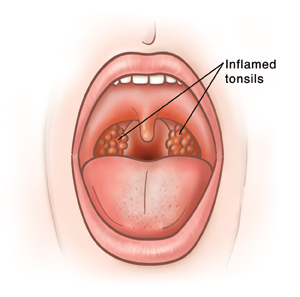
You or your child has an infection around the tonsils. This is sometimes caused by the streptococcus bacteria, so it's often called strep throat. The infection can cause severe sore throat, pain with swallowing, swollen glands, and fever.
Strep throat is treated with antibiotics.
Home care
-
All of the antibiotics should be taken as prescribed until they are gone. This is true even if symptoms start to get better. This is very important to ensure that the infection goes away. This helps prevent serious complications. It also helps keep the infection from spreading to other people.
-
Take acetaminophen (Tylenol) or ibuprofen (Advil, Motrin) for fever or pain. Do not use ibuprofen if your child is less than 6 months old unless the doctor gave you instructions to use it. Be safe with medicines. Read and follow all instructions on the label. Do not give aspirin to children or teens unless your child's doctor says it is safe. Aspirin can put your child at risk for Reye syndrome, a rare but serious condition.
-
To help ease pain, children older than 6 years and adults can gargle with warm saltwater. This can be done several times a day. Dissolve ¼ to ½ teaspoon of salt in 1 cup of warm water. Gargle with the solution, then spit it out. (Be sure that children don't swallow the saltwater.) Discuss this home care solution with the doctor to find out what solution is best for you or your child.
-
Cool liquids and soft foods may make eating easier for the first few days.
Follow-up care
Follow up with a doctor as advised.
When to get medical care
Contact the doctor right away if:
-
Symptoms get worse or new symptoms appear.
-
Symptoms go away and come back.
-
Your child refuses food and drink.
-
You or your child has trouble opening the mouth.
-
You or your child develop a rash.
-
Swelling or enlarged glands (that look like bumps) appear in the neck.
-
You or your child has neck stiffness.
Call 911
Call
-
Trouble swallowing.
-
Inability to eat or drink.
-
Trouble breathing.
-
Excessive drooling.
Prevention
Here are steps you can take to help prevent an infection:
-
Keep good handwashing habits.
-
Don’t have close contact with people who have sore throats, colds, or other upper respiratory infections.
-
Don’t smoke, and stay away from secondhand smoke.
-
Stay up to date with all of your vaccines.
Featured in
Online Medical Reviewer: Ashutosh Kacker MD
Online Medical Reviewer: Ronald Karlin MD
Online Medical Reviewer: Tara Novick BSN MSN
Date Last Reviewed: 06/01/2025
© 2000-2026 The StayWell Company, LLC. All rights reserved. This information is not intended as a substitute for professional medical care. Always follow your healthcare professional's instructions.
Related Articles
Understanding Nasal Anatomy: Outside View
Why does your nose look the way it does? And what goes on inside a nose to let a person breathe easily? Learning the anatomy of the nose can help you better understand the answers to these questions.
West Nile Virus
People may become infected with West Nile virus when they are bitten by an infected mosquito. Most WNV infections are very mild or cause no symptoms at all.
Understanding Nasal Anatomy: Inside View
Learning the anatomy of the nose can help you better understand how the nose works.
Uvulitis
Learn about caring for a child or an adult who has uvulitis.


