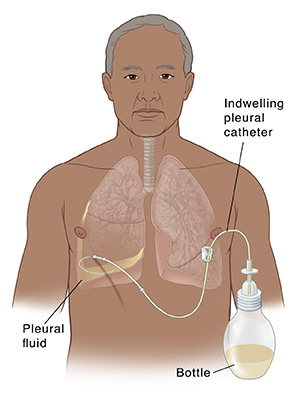
A buildup of excess of fluid around your lung is called a pleural effusion. It can make you short of breath by preventing your lung from opening up fully during breathing. One treatment for this problem is to use an indwelling pleural catheter (IPC). This is a thin, flexible tube that drains the fluid from around your lungs.
What is pleural effusion?
The pleura are two layers of thin, smooth tissue. They surround the lungs and line the chest. The area between these layers is called the pleural space. The pleural space normally has a small amount of fluid. This fluid lubricates the pleura as you breathe. Pleural effusion means that you have too much fluid between the pleura. It can cause pain or make it hard to breathe.
Getting the pleural catheter
The IPC is put in place with a minor surgery. Your skin is cleaned and numbed with medicine. The doctor makes a small cut (incision) in your skin. Then the catheter is gently put through the incision into the pleural space. Ultrasound or other imaging helps to guide this process. One end of the tube stays outside your skin. A small piece of extra material on the tube just inside the skin helps it stay in place. This piece of material is called a cuff.
The catheter will drain extra fluid and ease your breathing symptoms. When it's time to drain fluid, it can be attached to a small bottle. When not being used, the catheter is coiled next to your skin and covered with a dressing. The catheter will be left in place for weeks or months. Your care team will tell you how long it will stay in place.
Caring for your pleural catheter
-
Drain fluid with the catheter system exactly as instructed by your care team. You may need to do this every 1 to 2 days.
-
You can shower if your catheter site is fully covered with a secure dressing that sticks to your skin. Make sure there are no gaps around the edge. Follow any instructions from your care team.
-
Don’t let your catheter go underwater. This includes in a bathtub or pool.
-
If any part of the padding under the dressing gets wet, you will need to remove it. Change it for dry padding as instructed.
Preventing infection
While you have an IPC, the areas affected by the catheter are at risk for infection. If you have signs of infection, you will need to take antibiotic medicine.
To help prevent infection:
-
Wash your hands before you touch the dressing or catheter.
-
When draining fluid, use only clean supplies set up in a clean area.
-
Make sure the catheter is always clean, dry, and covered when you are not draining fluid.
-
Don’t go into a pool or hot tub.
Watch for signs of infection. These can include:
-
Fever of 100.4ºF (38ºC) or higher, or as directed by your doctor.
-
Pain that gets worse.
-
Redness, swelling, fluid, or warmth where the catheter goes into your skin.
-
Changes in the way the fluid looks.
When to contact your doctor
Contact your doctor right away if:
-
You have signs of infection (see above).
-
The small cuff just inside your skin has pulled out.
-
The catheter has started to pull out.
-
Not much fluid is draining.
-
You still find it hard to breathe after draining fluid.
-
Your symptoms don’t get better, or they get worse.
Date Last Reviewed: 06/01/2025
© 2000-2026 The StayWell Company, LLC. All rights reserved. This information is not intended as a substitute for professional medical care. Always follow your healthcare professional's instructions.
Related Articles
Using an Incentive Spirometer
An incentive spirometer is a handheld device that helps you do deep breathing exercises. Learn how to use it with these step-by-step instructions.
Resources for Chronic Lung Disease
You can do many things to help control COPD. Sticking to your treatment plan may not always be easy, but feeling your best depends on it. Read on for some pulmonary rehab programs, support groups, and other resources that can help you.
Pursed-Lip Breathing
Pursed-lip breathing can help you get more oxygen into your lungs when you're short of breath. Learn how and when to do it.
Chronic Lung Disease: My Travel Checklist
Chronic lung disease shouldn't stop you from traveling, visiting family and friends, and enjoying yourself—even if you use oxygen. Here are some helpful travel tips.


