Polycystic ovary syndrome (PCOS) causes harmless, small cysts in the ovaries and other symptoms. PCOS is caused by certain hormones being out of balance. The word syndrome means a group of symptoms. Women with PCOS may have no periods, irregular periods, or very long or heavy periods.
Your ovaries
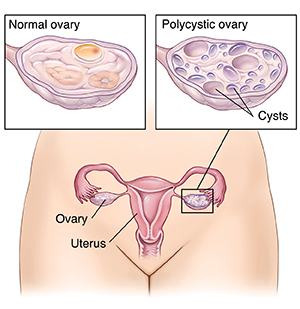
Women store their eggs in their ovaries. Each egg is in a capsule called a follicle. Normally during the reproductive years, one follicle grows to make a mature egg each month. This egg is released during ovulation and the follicle dissolves.
Hormones out of balance
With PCOS, the hormones that control ovulation are out of balance. These include estrogen, progesterone, and androgen. As a result, ovulation may not occur. Instead, the follicle stays enlarged. This is a fluid-filled sac called a cyst. Over time, the ovaries fill with many small cysts. This is why they are called poly or many cystic ovaries. In some women, the ovaries also make too much androgen.
Symptoms of PCOS
Women with PCOS may also have one or more of these symptoms:
-
Acne
-
Hair growth on the face and other parts of the body
-
Patches of thick, velvety, dark skin (acanthosis nigricans), often on the neck or groin area
-
Trouble getting pregnant (fertility problems)
-
Weight gain, often around the waist
Women with PCOS are also at greater risk of having cancer of the uterine lining, diabetes, and heart disease.
Featured in
Online Medical Reviewer: Donna Freeborn PhD CNM FNP
Online Medical Reviewer: Heather M Trevino BSN RNC
Online Medical Reviewer: Howard Goodman MD
Date Last Reviewed: 05/01/2025
© 2000-2026 The StayWell Company, LLC. All rights reserved. This information is not intended as a substitute for professional medical care. Always follow your healthcare professional's instructions.
Related Articles
Ovarian Cysts
Ovarian cysts are sacs filled with fluid or tissue that form on or inside the ovaries. There are different types of cysts. Most are harmless and go away on their own.
Cone Biopsy
A cone biopsy is a quick outpatient surgery used to find and treat a problem in the cervix. Read about how it's done and what to expect afterward.
Painful Menstrual Periods (Dysmenorrhea)
Dysmenorrhea happens when the uterus contracts very strongly, causing pain. This can occur on its own, or as the result of an underlying health problem.
Birth Control: Natural Family Planning
Natural Family Planning (NFP) is based on a woman's awareness of when she is fertile. By learning how to tell when you're fertile, you can know when to not have sex. This can help prevent pregnancy.


