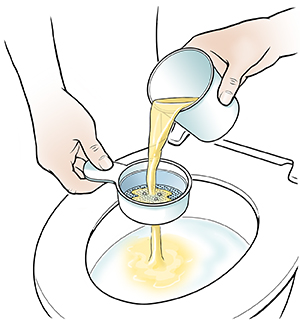
There are four general types of kidney stones. Your kidney stone’s size and shape determine whether it's likely to pass by itself. Knowing what a stone is made of (its composition) helps your health care provider find its cause and prescribe the best treatment. X-rays or scans can help show the stone's size and shape. Your provider may also give you a strainer to catch the stone while passing urine. The stone can then be sent to a lab for analysis. You may need other types of urine and blood tests to help identify the stone. These tests can also help find causes for different types of stones.
The tests can show:
-
Size. A stone may be as small as a grain of sand. Some may be the size of a pebble. A few may be as large as a golf ball. Small stones may pass out of your body when you urinate.
-
Shape. Small, smooth, round stones may pass easily. Jagged-edged stones often lodge inside the kidney or ureter. Staghorn stones can fill the entire renal pelvis and calyces.
-
Composition. Most stones are made of calcium oxalate, a hard compound. Stones made of uric acid or cystine or that are caused by infection (struvite stones), are less dense. Stones often contain more than one chemical.
Treating your stones
You and your health care provider will work together to form a treatment plan. Your provider may suggest that you let your stone pass naturally. Or you may choose to manage it with medicines. Certain procedures may also help, such as shock wave lithotripsy or using a thin tube with a camera inside the body to remove the stone (ureteroscopy). When they find out the cause of the stone, you will be told how you can help prevent kidney stones in the future.
Featured in
Online Medical Reviewer: Daphne Pierce-Smith RN MSN
Online Medical Reviewer: Lalitha Kadali
Online Medical Reviewer: Melinda Murray Ratini DO
Date Last Reviewed: 04/01/2025
© 2000-2026 The StayWell Company, LLC. All rights reserved. This information is not intended as a substitute for professional medical care. Always follow your healthcare professional's instructions.
Related Articles
Healthy Kidneys
Learn about the kidneys--where they're located, how they filter waste from the blood, and their other roles in keeping the body healthy.
Ultrasound
Ultrasound imaging is a test that uses sound waves to make detailed pictures of your organs. There are three different kinds of ultrasound imaging: abdominal, pelvic, and Doppler ultrasound. Each of these imaging tests can help your healthcare provider assess pain or other symptoms in different parts of your body. Ultrasound does not involve any radiation, and is generally a very safe procedure. Still, you should discuss any concerns with your healthcare provider.
Medical Genetics: Chromosome Studies
When a chromosome is abnormal, it can cause health problems in the body. Tests called studies can look at chromosomes to see what type of problem a person has.
Preparing the Family
Most families soon find ways to adjust to the changes that take place after a baby is born. But it's helpful to prepare family members for what's ahead.


