Sacral nerve stimulation helps treat bladder problems caused by diseases of the nervous system. It's often done after medicine or other treatments don't work. The nerves that help you pass pee (urine) may not be working the right way. As a result, you may have trouble holding your pee or emptying your bladder.
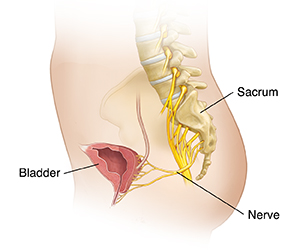
Before sacral nerve stimulation is done, you need a trial or test procedure to see if it will work. This is called percutaneous nerve evaluation (PNE). During PNE, the health care provider puts temporary electrodes (leads) in the nerves in your sacrum. The sacrum is the lowest part of your spine. It's connected to your pelvis.
After the leads are placed, the provider connects them to a pulse generator. This external device sends signals to the leads. When you turn the device on, it stimulates the nerves in your bladder. It helps you control when you pee.
Why PNE is done
PNE is done to see if sacral nerve stimulation may help with your bladder problems.
How PNE testing for sacral nerve stimulation is done
PNE is often done in an outpatient facility. That means you can leave shortly after it's done. During the procedure:
-
You lie face down on an exam table.
-
You're given medicines so you don’t feel any pain. They may also make you sleepy.
-
The provider finds the right place to put the leads in your sacrum. They may use fluoroscopy to do so. It’s a type of X-ray imaging.
-
The provider injects a needle into the correct spot. They then put a lead through the needle.
-
The provider checks that the lead is in the correct place. The needle is then removed.
-
The provider tapes the part of the lead outside of your body to your skin before connecting it to a pulse generator.
-
You'll have the temporary leads for 3 to 5 days. Then they'll be removed in the clinic.
Risks of PNE testing for sacral nerve stimulation
The risks of PNE testing include:
-
The lead moving out of place.
-
Pain.
-
Infection.
Featured in
Author: Semko, Laura
Online Medical Reviewer: Donna Freeborn PhD CNM FNP
Online Medical Reviewer: Marc Greenstein MD
Online Medical Reviewer: Raymond Kent Turley BSN MSN RN
Date Last Reviewed: 04/01/2025
© 2000-2026 The StayWell Company, LLC. All rights reserved. This information is not intended as a substitute for professional medical care. Always follow your healthcare professional's instructions.
Related Articles
Cystography
Cystography is an imaging test that can help diagnose problems in your bladder. It uses X-rays. They may be X-ray pictures or fluoroscopy, a kind of X-ray "movie."
Retrograde Cystography
Retrograde cystography is an imaging test that uses X-rays with contrast dye so the radiologist can see your organ or tissues more clearly. Learn more about this test, including what to expect before, during, and after the test.
Syphilis
Syphilis is a very serious bacterial infection. Learn about symptoms, treatment, and prevention.
Gonorrhea
Gonorrhea is a bacterial infection that is transmitted sexually. Many women and some men who have gonorrhea don't have any signs or symptoms. Here's what you should know.


