Bones can break anywhere in the body. There are many types of bone breaks (fractures). The goal of treatment is to:
- Put the pieces of bone back in place.
- Control the pain.
- Give the bone time to heal.
- Prevent problems.
- Help you be able to use the broken-bone area normally after the bone heals.
Treatment may include a splint or cast, medicine, traction, surgery, or external fixation.
How bones break
Fractures most often happen when more force is put on the bone than the bone can take. Bone fractures can be caused by a fall, injury, or direct hit or kick to the body. Overuse or repetitive movements can tire muscles and put more pressure on the bone. This causes stress fractures. Fractures can also be caused by diseases that weaken the bone. Depending on the injury, bones can break in different ways.
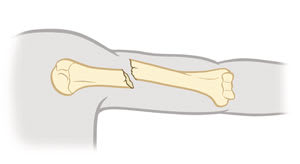
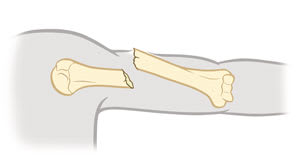
A fracture is a partial or complete break in the bone. When a fracture happens, it's classified as either closed or open.
Closed fracture
The bone does not break through the skin. This is also known as a simple fracture.
Open fracture
The bone breaks through the skin. This is also known as a compound fracture.
Other types of fractures
Fractures have many names. Below are some common types of fractures. You may have a fracture that's not listed here.
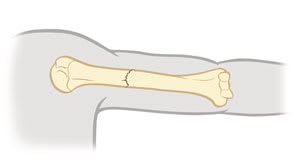
Non-displaced fracture
Bone fragments (pieces) are lined up.
Displaced fracture
Bone fragments are not lined up. A gap exists between both ends of the broken bone.
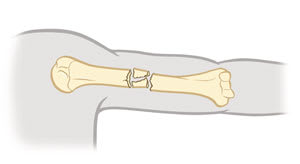
Comminuted fracture
The bone is broken into three or more pieces.
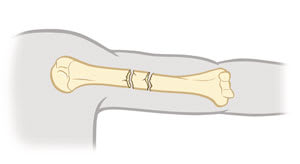
Segmental fracture
The same bone is broken in two places, so there is a floating piece of bone.
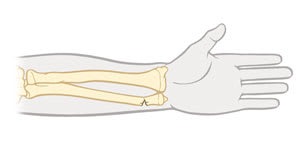
Greenstick fracture
The bone bends, but it may not break all the way. This happens most often in children, whose bones are softer and still growing.
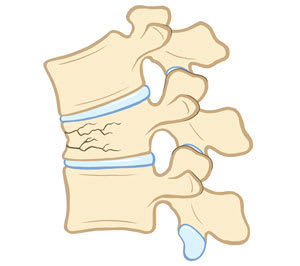
Compression fracture
The bone is crushed. This causes the broken bone to be wider or flatter in appearance.
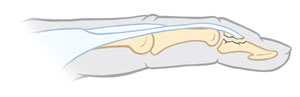
Avulsion fracture
The bone is broken near a tendon or ligament. A tendon or ligament pulls off a small piece of bone.
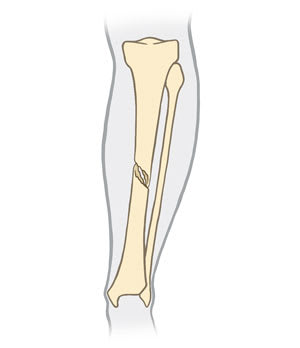
Spiral fracture
The break spirals around the bone. This is common in a twisting injury.
Online Medical Reviewer: Raymond Turley Jr PA-C
Online Medical Reviewer: Rita Sather RN
Online Medical Reviewer: Thomas N Joseph MD
Date Last Reviewed: 02/01/2024
© 2000-2026 The StayWell Company, LLC. All rights reserved. This information is not intended as a substitute for professional medical care. Always follow your healthcare professional's instructions.

Related Articles
What Are Mallet, Hammer, and Claw Toes?
Mallet, hammer, and claw toes are among the most common foot problems. They are often caused by wearing shoes that are too short or heels that are too high.
The Shoulder Joint
The shoulder is made up of bones, muscles, ligaments, and tendons. Learning about the parts of the shoulder joint will help you to understand your shoulder problem.
Anatomy of the Sacroiliac Joint
Learn the anatomy of the sacroiliac joint.
Your Neck Muscles
Illustration and explanation of neck muscles.


