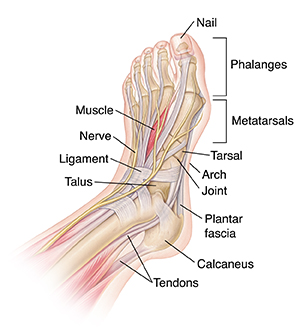
Your foot is made up of soft tissue and bones that work together to form a healthy, functioning, and pain-free foot.
-
Muscles contract and relax to move the foot.
-
Tendons are tough fibers that connect muscles to bones.
-
Ligaments are fibrous strands that connect bones.
-
Nerves travel throughout the foot, providing feeling.
-
Nails protect the tips of the toes.
-
Phalanges are the toe bones.
-
Metatarsals are the bones between the toes and the ankle bones.
-
Tarsals are bones of the rear foot (hindfoot) or middle foot (midfoot).
-
The talus is one of the ankle bones.
-
The calcaneus is the heel bone.
-
The arch is formed by bones and held in place with ligaments.
-
Joints are the meeting points between two bones. They are lined with cartilage. Cartilage is smooth tissue that allows joints to move easily.
-
The plantar fascia is a sheet of fibrous tissue that supports the arch and encloses muscles there.
Online Medical Reviewer: Raymond Turley Jr PA-C
Online Medical Reviewer: Stacey Wojcik MBA BSN RN
Online Medical Reviewer: Thomas N Joseph MD
Date Last Reviewed: 08/01/2022
© 2000-2026 The StayWell Company, LLC. All rights reserved. This information is not intended as a substitute for professional medical care. Always follow your healthcare professional's instructions.

Related Articles
Anatomy of the Shoulder
The shoulder is a complex joint with several layers, including bones, ligaments, tendons, and muscles.
The Kneecap (Patella) in Action
As the leg moves, the kneecap moves, too. It slides up and down its track on the thighbone. But if the kneecap slides “off track”—even a little—pain and damage can result.
Anatomy of the Spine
Your backbone, also called the vertebral column, is made up of 33 vertebrae separated by spongy disks.
What Are Corns and Calluses?
Corns and calluses can form on the foot due to rubbing or pressure.


