A bone density study helps diagnose brittle bones (osteoporosis). Scans of your lower back, hip, or forearm are taken to measure the amount of calcium (density) in your bones. Calcium is the mineral that makes up your bones.
What to tell your technologist
Tell the technologist if you:
-
Are pregnant or think you could be pregnant.
-
Have any metal in the part of your body being imaged, such as a hip replacement.
-
Have had a recent nuclear medicine scan, CT scan with oral contrast, or an X-ray test with oral contrast such as a barium enema, barium swallow, or upper GI.
-
Have a severely curved spine.
-
Have had spinal surgery.
-
Have a history of spinal or hip fractures.
-
Can’t lie on your back.
Before your test
-
Wear clothing without metal closures, such as zippers or metal buttons.
-
Bring a list of medicines that you take.
During your test
-
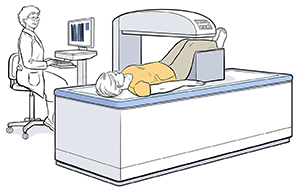
You will lie on a table or sit.
-
Your lower legs may be raised on a platform.
-
A scanner arm moves back and forth over the part of your body being scanned.
-
Stay still and don't talk during the scan.
-
Follow instructions. This can help prevent the need for a second exam.
After your test
-
You may need to wait for a short time while the images are reviewed.
-
Your doctor will discuss the test results with you during a follow-up visit or over the phone.
Your next appointment is:
Online Medical Reviewer: Jessica Gotwals RN BSN MPH
Online Medical Reviewer: Neil Grossman MD
Online Medical Reviewer: Raymond Turley Jr PA-C
Date Last Reviewed: 06/01/2025
© 2000-2026 The StayWell Company, LLC. All rights reserved. This information is not intended as a substitute for professional medical care. Always follow your healthcare professional's instructions.

Related Articles
Bone Scan
A bone scan is an imaging test that uses a special camera to form images of your bones. Learn why it's done, how to get ready for it, and what to expect before, during, and after the test.
Diagnosing Bone Disorders
Detailed information on diagnostic procedures for bone disorders, including bone densitometry, radionuclide bone scan, and biopsy.
Evaluating Kneecap (Patella) Problems
You can find out what is causing your knee pain by having a thorough evaluation. You may see an orthopedist or a sports medicine healthcare provider. They treat bone, muscle, and joint problems. Your healthcare provider will work with you to find the cause of your knee pain and design a treatment plan for you.
Arthroscopy: Overview
Arthroscopy is a minimally-invasive procedure used to diagnose and treat conditions affecting joints. The doctor can directly view the internal structures of a joint using an instrument called an arthroscope. An arthroscope is a small, tube shaped instrument that is used to look inside a joint.


