If a school screening or your healthcare provider finds signs of scoliosis, you’ll visit an orthopedist for an evaluation. An orthopedist is a healthcare provider who treats bones and muscles. This visit helps figure out what treatment may be best for you.
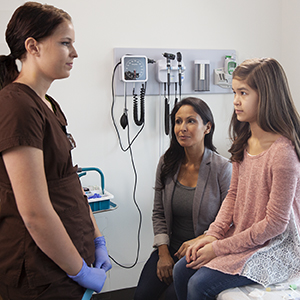
During your evaluation
Your orthopedist may:
-
Ask you about your health history, such as if you’ve ever had surgery
-
Ask about your family health history, such as if someone in your family has scoliosis
-
Take X-rays of your back to get a closer look at your spine
-
Estimate how much more you are likely to grow. You may be asked if you've gotten your period yet.
-
Examine your back while you’re standing up and bending over
-
Measure the size, location, and pattern of the spinal curve
-
Test how flexible your spine is, and how strong your back and neck muscles are
Why treat scoliosis?
A serious spinal curve that isn’t treated can get worse as you grow. Over time, it may cause problems. These can include:
-
Back pain
-
Arthritis in your back
-
Your body looking twisted
-
Clothes not fitting right
-
Heart and breathing problems (rare)
Online Medical Reviewer: Raymond Turley Jr PA-C
Online Medical Reviewer: Stacey Wojcik MBA BSN RN
Online Medical Reviewer: Thomas N Joseph MD
Date Last Reviewed: 04/01/2024
© 2000-2026 The StayWell Company, LLC. All rights reserved. This information is not intended as a substitute for professional medical care. Always follow your healthcare professional's instructions.

Related Articles
Arthrogram
An arthrogram is an imaging study used to assess your joint problem.
X-rays of the Spine, Neck, or Back
This procedure may be used to diagnose back or neck pain, fractures or broken bones, arthritis, degeneration of the disks, tumors, or other problems.
Confirmed Scaphoid Wrist Fracture
A scaphoid fracture is a fracture in one of the small bones of the wrist. This bone heals slowly. Some scaphoid fractures don't heal correctly, and may need surgery.
Diagnosing Bone Disorders
Detailed information on diagnostic procedures for bone disorders, including bone densitometry, radionuclide bone scan, and biopsy.