Bending can strain or even injure your back. Follow the tips below to move safely and protect your back as you perform everyday activities.
Bending over
-
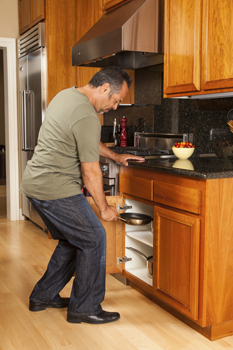
Keep your feet shoulder-width apart.
-
Move your whole body as one unit.
-
Bend at your hips and knees, not at your waist.
-
Flatten your stomach and tighten your leg muscles.
-
To keep your spine straight, let your buttocks move out behind you. Don’t try to tuck them under.
-
If you need to, place one hand on a sturdy object for support.
Bending to the floor
-
Lower yourself to one knee. If you can, rest one hand on a sturdy object to help lower yourself.
-
Rest one arm on your raised knee.
-
Don’t bend at the waist.
-
Don't hunch your back or neck to reach to the floor. Instead, bend more at your hips and knees to get closer.
Online Medical Reviewer: Louise Cunningham RN BSN
Online Medical Reviewer: Raymond Turley Jr PA-C
Online Medical Reviewer: Thomas N Joseph MD
Date Last Reviewed: 09/01/2023
© 2000-2026 The StayWell Company, LLC. All rights reserved. This information is not intended as a substitute for professional medical care. Always follow your healthcare professional's instructions.

Related Articles
Plaster Splint Care
Here are directions to care for your splint at home.
Hip Safety: Getting Into and Out of Bed
After hip replacement surgery, getting in and out of bed can be difficult. These instructions can help.
Wearing a Rib Belt
A rib belt is an elastic strap that may help reduce pain from chest muscle strain or rib fracture.
Back Safety: Sitting
Sitting can strain your back if you don't do it right. Learn the right moves to protect your back.