Follow these guidelines when caring for your splint:
-
It will take up to 2 hours for your fiberglass splint to fully harden. Don’t put any pressure on it during that time or it may break.
-
To prevent swelling under the splint, do this for the first 2 days (48 hours):
-
For a splint on your arm, keep it in a sling or raised to shoulder level when you are sitting or standing. Rest it on your chest or on a pillow at your side when you are lying down.
-
For a splint on your foot, keep it propped up above the level of your heart when sitting or lying. Avoid crutch walking as much as possible during this time.
-
-
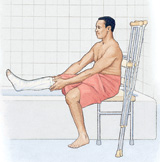
Keep the splint dry at all times. Bathe with your splint well out of the water. Protect it with 2 large plastic bags and tape each bag separately at the top end. If a fiberglass splint gets wet, you can dry it with a hair dryer on the cool setting.
-
Put an ice pack on the injured area. Do this for 20 minutes every 1 to 2 hours the first day for pain relief. To make an ice pack, put ice cubes in a plastic bag that seals at the top. As the ice melts, be careful that the splint doesn’t get wet. Keep using the ice pack 3 to 4 times a day for the next 2 days. Then use it as needed to ease pain and swelling.
-
Your health care provider may prescribe medicines for pain or swelling. Follow your provider’s instructions for taking these medicines. If no pain medicine was prescribed, you may use acetaminophen or ibuprofen to control pain. If you have chronic liver or kidney disease, talk with your provider before using these medicines. Also talk with your provider if you’ve had a stomach ulcer, gastrointestinal bleeding, or take a blood thinner.
-
Don't stick anything inside the splint, such as a coat hanger. Don't apply any powders or creams. If itching continues, call your provider.
-
Look at the skin near the cast regularly. If skin becomes red or raw, call your provider.
Follow-up care
Follow up with your health care provider as advised.
When to get medical advice
Contact your health care provider right away if you have:
-
A bad odor from the splint or wound fluid that stains the splint.
-
A splint that cracks or stays wet for more than 24 hours.
-
Tightness or pressure under the splint that gets worse.
-
Fingers or toes that become swollen, cold, blue, numb, or tingly.
-
Fingers or toes that you can't move.
-
Pain under the splint that gets worse.
-
Skin around the splint that becomes red, irritated, or swollen.
-
A fever of more than 100.4°F (38°C) or higher, or as advised.
-
Chills.
Online Medical Reviewer: Rahul Banerjee MD
Online Medical Reviewer: Stacey Wojcik MBA BSN RN
Date Last Reviewed: 02/01/2025
© 2000-2026 The StayWell Company, LLC. All rights reserved. This information is not intended as a substitute for professional medical care. Always follow your healthcare professional's instructions.

Related Articles
Thumb Dislocation
How to care for your thumb after you've had a dislocation.
Shoulder Immobilizer
A shoulder immobilizer is designed to hold your arm against your body. It is used for injuries where you need to limit how much you can move your shoulder. These injuries include a shoulder dislocation or shoulder fracture. Moving your shoulder too much could cause harm.
Hip Bruise
A hip contusion can cause swelling, pain, and changes in skin color. Here's how to care for yourself at home.
Back Safety: Pushing and Pulling
Pushing can be hard on your back, but pulling can be even harder. So, push rather than pull when you can.


