Being relaxed helps keep your mind healthy and your back ready to move. Take short breaks often. Walk around. Stretch. Switch tasks. And give these relaxation methods a try.
Deep breathing
Deep breathing is a simple way to reduce stress. You can do it almost any time you need to relax.
-
Breathe in slowly through your nose. Let your lungs and stomach expand.
-
Hold your breath for
2 to 3 seconds. -
Breathe out slowly through your mouth until your lungs feel empty. Repeat
3 to 4 times.
Guided imagery
This method helps you to visualize a calming environment. It uses all 5 senses to create a deeper sense of relaxation. Guided imagery can be done on your own. Or you can listen to someone talk you through it.
-
Step 1. Sit or lie down in a comfortable space. Make sure there are no distractions.
-
Step 2. Visualize a relaxing place. It could be a place you've been before. Or it may be a place you imagine.
-
Step 3. Using your 5 senses, focus on what you see, hear, smell, taste, and feel in this place.
Take slow, deep breaths during this exercise. Focus on how calm this relaxing place makes you feel.
Box breathing
This is a type of deep breathing exercise. As the name suggests, it helps to visualize a box with 4 equal sides as you do the exercise. Box breathing can be very helpful with relaxation.
It is done in 4 easy steps:
-
Step 1. Breathe in through your nose for a count of 4.
-
Step 2. Hold your breath for a count of 4.
-
Step 3. Breathe out for a count of 4.
-
Step 4. Hold your breath for a count of 4.
-
Repeat.
Adjust the length of the steps as needed (for instance, 2 seconds instead of 4 seconds for each step).
Relieve tension
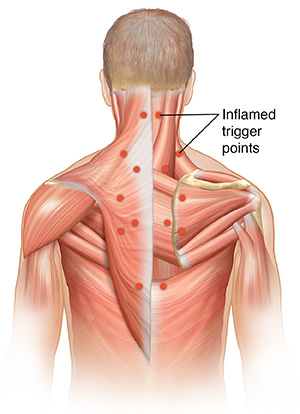
Muscle tension can create tender spots called trigger points. The tips below may help ease muscle tension.
-
Press the trigger point if you can reach it. If not, lie on a soft tennis ball, or ask a friend to press the spot. Use steady pressure for
10 to 15 seconds. Breathe deeply. Repeat a few times. -
Massage trigger points with ice for
2 to 5 minutes. Press lightly at first. Slowly increase firmness.
Progressive muscle relaxation
This is a widely used relaxation method. It is sometimes called deep muscle relaxation. The aim is to become more aware of your body and learn to become physically and mentally relaxed. It also helps to reduce muscle tension caused by stress. Relaxing in this way can help you cope better with stress.
-
Start by focusing on a certain group of muscles.
-
First, actively relax these muscles.
-
Then tense the muscles for a short while.
-
Next, fully relax them again.
-
Repeat these steps with other muscle groups until your whole body is relaxed.
Be careful not to tense to the point of physical pain. And be mindful to take slow, deep breaths throughout the exercise.
Online Medical Reviewer: Marianne Fraser MSN RN
Online Medical Reviewer: Raymond Turley Jr PA-C
Online Medical Reviewer: Vinita Wadhawan Researcher
Date Last Reviewed: 04/01/2024
© 2000-2026 The StayWell Company, LLC. All rights reserved. This information is not intended as a substitute for professional medical care. Always follow your healthcare professional's instructions.

Related Articles
Tips After Knee Surgery
Follow these tips during your recovery after knee surgery.
Radial Deviation (Strength)
Follow the step-by-step instructions for this wrist exercise.
Heel Cord (Gastrocnemius) Stretch (Flexibility)
Stand facing a wall from 3 feet away. Take one step toward the wall with your right foot. Place both palms on the wall. Bend your right knee. Lean forward, keeping the left leg straight and the left heel on the floor. Hold for 5 to 10 seconds.
Arch Retraining
These exercises help strengthen your arches.


