Your health care provider has prescribed a walker for you. To use your walker, you need to learn new ways to get around. A walker can help you when you get up from and sit down on a chair or other furniture. If you have had your hip replaced, you may need special instructions. Ask your provider or physical therapist to show you the best way to move safely.
General guidelines
Here are some general tips:
-
Remove things in your home that may cause you to fall, such as electrical cords or small rugs.
-
Arrange your household to keep the items you need handy. Keep everything else out of the way.
-
Keep your hands free by using a backpack, fanny pack, apron, or pockets to carry things.
To sit down
To sit down using a walker:
-
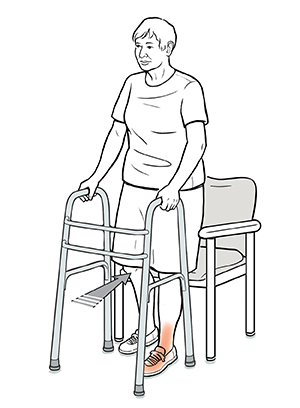
Back up until you feel the chair behind you. If you have an injured leg, knee, or hip, extend that leg a little bit out in front of you.
-
Bend forward at your hips.
-
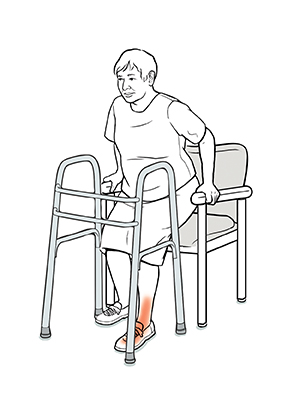
Reach behind you with one hand and grab the armrest or the side of the chair.
-
Now do the same with the other hand.
-
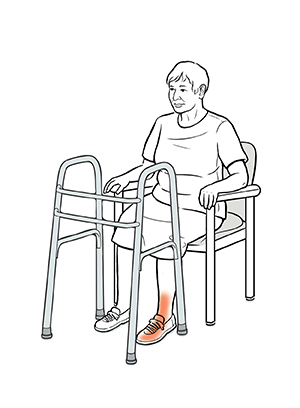
Lower yourself onto the center of the chair, then slide back.
To stand up
To stand up using a walker:
-
Slide forward in the chair until both your feet are firmly on the floor and you can reach the crossbar of the walker.
-
Hold the crossbar of the walker with one hand and the arm of the chair with the other. Never try to use only the walker to stand up. The walker could tip over.
-
Raise yourself slowly off the chair.
Online Medical Reviewer: Daphne Pierce-Smith RN MSN
Online Medical Reviewer: Shaziya Allarakha MD
Online Medical Reviewer: Trina Bellendir PT
Date Last Reviewed: 02/01/2025
© 2000-2026 The StayWell Company, LLC. All rights reserved. This information is not intended as a substitute for professional medical care. Always follow your healthcare professional's instructions.

Related Articles
Protecting Your Foot After Foot Surgery
To help the bone heal properly, you may need to wear a cast. If you do, always keep it dry. Your healthcare provider will tell you whether you can bear weight on your foot while it heals. They may also prescribe a surgical shoe for you to wear.
Discharge Instructions for Elbow Arthroscopy
Instructions for taking care of yourself after elbow arthroscopy.
Discharge Instructions for Knee Arthroscopy
Information on how to care for yourself after knee arthroscopy.
Headache After Spinal Tap (With Patch)
After the patch, you should start to feel better soon. Improvement often continues over the next several days.


