After amputation surgery, you’ll need to stretch and strengthen your residual limb. This will help prevent shortening of muscles and tightening of joints. You need to keep your residual limb strong and flexible in order to use a prosthesis. A physical therapist will teach you exercises to strengthen your lower body. You may begin working with the physical therapist before or after surgery. You’ll need to keep doing these exercises once you go home or as directed. Follow all instructions from the physical therapist closely. If you have any questions, be sure to ask them. Below are some of the exercises you may learn.
Starting position
These exercises can be done on a firm bed or other flat, comfortable surfaces.
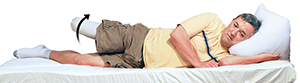
Hip abduction
-
Lie on your side with your residual limb on top. Support your head with your arm or a pillow.
-
Make sure your hips are straight up and down, not leaning forward or back. Keep your natural limb bent slightly on the bed for support.
-
Slowly lift your residual limb toward the ceiling. Don’t let your hip fall backward as you lift.
-
Hold for a few seconds at the top of the movement.
-
Slowly lower residual limb and relax.
-
Repeat
10 times. Do1 set1 time a day.
Prone hip extension

-
Lie flat on your stomach. Support your head with your arms or a pillow.
-
Keeping your hips flat on the bed, slowly raise your residual limb toward the ceiling. Don’t twist or raise your hip as you lift. Keep your natural limb flat on the bed and relaxed.
-
Hold for a few seconds or as directed by your physical therapist or healthcare provider.
-
Slowly lower your residual limb and relax.
-
This exercise may also be repeated with your natural limb.
-
Repeat
10 times. Do1 set1 time a day.
Proning

-
Lie flat on your stomach. Support your head with your arms or a pillow.
-
Keep your natural limb stretched out straight.
-
Keep hips flat on the bed. Try not to twist or raise your hip on the residual limb side.
-
Breathe deeply and relax, letting gravity stretch your hip muscles.
-
Hold for
30 minutes. Repeat3 times a day.
Online Medical Reviewer: Daphne Pierce-Smith RN MSN
Online Medical Reviewer: Thomas N Joseph MD
Online Medical Reviewer: Trina Bellendir PT
Date Last Reviewed: 09/01/2023
© 2000-2026 The StayWell Company, LLC. All rights reserved. This information is not intended as a substitute for professional medical care. Always follow your healthcare professional's instructions.

Related Articles
Using Crutches with Step To (Weight Bearing)
These images show the use of crutches with step to.
Protecting Your Foot After Foot Surgery
To help the bone heal properly, you may need to wear a cast. If you do, always keep it dry. Your healthcare provider will tell you whether you can bear weight on your foot while it heals. They may also prescribe a surgical shoe for you to wear.
Discharge Instructions for Knee Arthroscopy
Information on how to care for yourself after knee arthroscopy.
Using Crutches with Step Through (Weight Bearing)
These images show how to use crutches with step through (weight bearing).


