As you recover from amputation, you’ll need to keep your upper body strong. This will help you move between surfaces, such as your bed and wheelchair. A physical therapist will teach you exercises to strengthen your upper body. You may begin working with the physical therapist before or after your surgery. You’ll need to keep doing these exercises once you go home. Follow all instructions from the physical therapist or healthcare provider closely. If you have any questions, be sure to ask. Below are some of the exercises you may learn.
Starting position
The following exercises can be performed in a sturdy chair without wheels or a wheelchair with the wheels locked. Make sure your residual limb is supported and straight, not bent or dangling. Keep your wrists, neck, and back straight and aligned. Don’t hunch over.
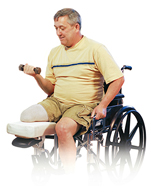
Bicep curls
-
Place your foot flat on the floor.
-
Sit up straight. Grasp a
2 -pound weight or rubber exercise band (as directed by your physical therapist). If using a band, secure the end beneath your foot or the bottom of the chair. -
Turn your wrist upward with your arm resting on your knee.
-
Keep your elbow close to your body and your wrist straight. Slowly bend your elbow, moving your hand up toward your shoulder.
-
Slowly lower your hand back down.
-
Repeat
10 times with each arm. Do2 sets1 time a day.
Seated press-ups
-
Place your foot flat on the floor.
-
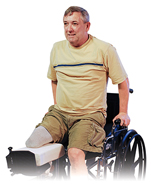
Sit up straight. Grasp the armrests of the chair with both hands, palms down.
-
Press down, lifting your buttocks straight up from the chair.
-
Hold for a few seconds.
-
Bend your elbows and slowly ease back down to seated position.
-
Repeat
10 times. Do2 sets1 time a day.
Seated rows
-
Place your foot flat on the floor.
-
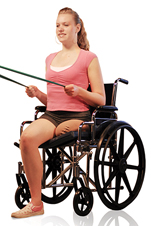
Secure the middle of a rubber exercise band in a doorjamb. Place it at about elbow height.
-
Grasp one end of the band in each hand with your elbows close to your sides.
-
Smoothly pull both arms back, keeping elbows close to your body. Gently squeeze your shoulder blades together.
-
Hold for a few seconds.
-
Slowly return your arms to starting position.
-
Repeat
10 times. Do2 sets1 time a day.
Online Medical Reviewer: Daphne Pierce-Smith RN MSN
Online Medical Reviewer: Thomas N Joseph MD
Online Medical Reviewer: Trina Bellendir PT
Date Last Reviewed: 09/01/2023
© 2000-2026 The StayWell Company, LLC. All rights reserved. This information is not intended as a substitute for professional medical care. Always follow your healthcare professional's instructions.

Related Articles
Managing Pain After Amputation Surgery
You may have different types of pain after amputation. Talk with your doctor about your pain to get the best treatment.
Your Scoliosis Brace
A brace helps stop the curve in your spine from getting worse as you grow. It may also help keep you from needing surgery. To do the job, the brace needs to be worn almost all the time until you are fully grown.
Sitting with Crutches (Weight Bearing)
These images show how to sit safely with crutches.
Fitting Your Crutches
Correct fitting helps you use your crutches safely. When fitting crutches, stand up straight and wear the shoes you will normally use to walk.


